Artificial intelligence has not changed how I write my articles, but to some extent it has changed the research process. While I have to be careful to verify information and sources, I would never depend upon it to write material for me or for editing. I suppose you could say that I don’t trust it at all. And yet I’ve used it many times in limited circumstances.
I’ve heard others who write better and more often than I do joke about how easy and irresistible it is for fact-checking, and I would agree. There is a creeping tendency to rely more and more on AI to sift through information and offer conclusions. I’m not a professional writer, but I’ve heard some of them on TV admitting they edit with it, which is not surprising. It’s becoming routine, and abuses will increase as AI’s sophistication improves. It is now part of the paradoxical human tendency toward dependency and pride. This applies to everyone from people like me to doctors, lawyers, and scientists.
G. K. Chesterton once wrote that “our Faith is a lifeboat. It is no mere blind leap into the void; it is a rescue from the sea”. It rescues us in those times when reason falls short. His words were written over a hundred years ago but nevertheless apply to any time period before or since. We live in a world that is constantly throwing problems and turmoil at us, often relentlessly. We are ill-suited to protect ourselves without our Catholic faith. Our advancing technology has added a new dimension to our already precarious situation. Human reason helps us set boundaries, but only our Faith can provide the moral determination necessary to safeguard mankind in these turbulent times.
Artificial Intelligence is unlike any other technological development in its breadth and scope and in its potential to change life forever. The question is whether or not we are better off with it or without it, although it is here to stay. The answer may very well involve our ability to be its master rather than servant. We will get one chance at achieving this and then live with the consequences, good or bad. It’s a threat of biblical proportions, with a technology that has a huge upside as well as the potential to destroy us.
AI is not capable of cognition, empathy, morality, forgiveness, or love and does not have free will. It is bound by programming and algorithms, not by any conscious desire to do good or evil. It synthesizes vast amounts of data at a superhuman speed, produces conclusions, and is being used to increase efficiency in every aspect of our lives, from transportation to medical science.
AI will probably replace people in the workforce with machines and might possibly force the government to someday pay universal income to people so that they can live. In this way, it has the potential to create oligarchies. The government or whoever has control over these vast information sources would have enormous power over our lives, and freedom would suffer, as would privacy. The potential for cybercrime would increase exponentially.
Perhaps the best examples of AI’s pros and cons are found in the medical field, where processing huge amounts of research and clinical data is now easy. This can lead to much faster diagnoses, however, there is the danger of false information sneaking in, making verification difficult. Right now, doctors may have discretion, but what about the future? As AI grows more and more sophisticated, at what point may we begin deferring to it on life’s most important issues? Is it possible for human beings to misuse AI and become overly dependent
upon it, relegating it to an almost oracle-type status? At what point does the “Tree of Knowledge”, promising to make us godlike, become impossible to resist or just plain easier? The danger is probably not so much from the technology itself as it is from our fallen nature and our possible tendency to overly rely upon it. Just as a certain type of government can destroy human initiative over time, this can too. Many people who suffer from loneliness are also susceptible to this technology.
In the Old Testament, the Israelites repeatedly yielded to the temptation to worship false gods. Even King Solomon, with all that wisdom, eventually fell victim to this grave sin. In ancient times, paganism, inspired by demons, took the form of statues and corresponding cults which often encouraged human and even child sacrifice. People often attempted the spiritual shortcut of going the easier way, around God. It always ended badly for those committing such grave sin, yet it kept happening. In that world, people sought faster worldly results by turning to idolatry. They were tired of waiting for God to help them, although he always had in some pretty incredible ways. People are not very patient and always seem to have trouble moderating their behavior. Anything can become a false god if it is heretically worshipped or even indulged by people seeking worldly goals of a selfish nature. In fact, worshiping one’s self has become quite fashionable. The pursuit of money, power, beauty, and success now permeates our existence to a disproportionate level. In the Bible, self-idolatry or pride often preceded actual paganism. From our Faith’s perspective, the ancient question has been and always will be “how do we fight the enemy in his own backyard? How do we resist the fallen world and its temptations in whatever form they take? Convenience, knowledge, and power are very seductive.
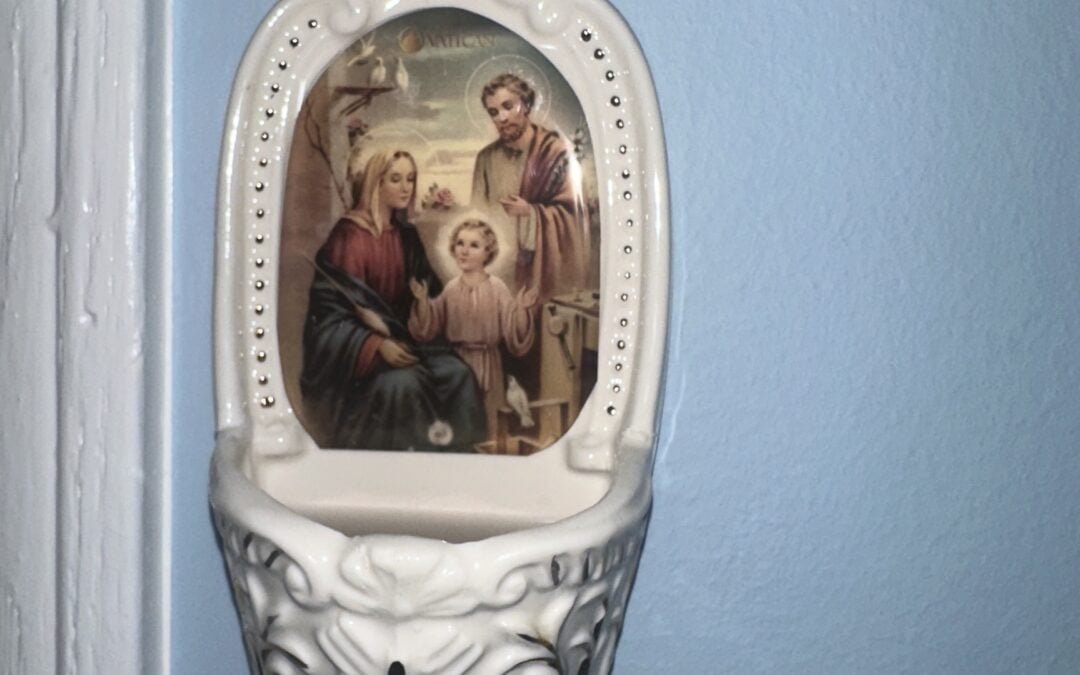
In light of these two images, the Holy Spirit challenges us today regarding our relationship with technology and the ongoing digital revolution. Scientific discoveries are talents entrusted to humanity so that they may bear fruit (cf. Mt 25:14-30). Technology has the power to heal, connect, educate and protect our common home; but it can also divide, exclude and generate new forms of injustice. In the abstract, technology in and of itself is not a solution to humanity’s problems, just as it is not inherently evil. In practice, however, technology is never neutral, because it takes on the characteristics of those who devise, finance, regulate and use it. Therefore, the primary choice is not between a “yes” or “no” to technology, but rather between constructing Babel or rebuilding Jerusalem; between a power that claims to dominate the heavens and a people who work together in the presence of God to rebuild the walls of fraternal coexistence.
Pope Leo XIV | MAGNIFICA HUMANITAS
One thing is certain: our technological prowess now outpaces any government’s ability to restrain or regulate AI. Without such restraint, in a largely secular society, people will be defenseless. The negative aspects of AI could cause society to descend into anarchy by spreading misinformation, according to Magis AI, a Catholic AI search engine created by Fr. Robert Spitzer, author and physicist. The irony does not escape me. Fr. Spitzer has written and spoken about the advantages and disadvantages of AI, pointing out its lack of moral agency. This is exemplified by stories of AI chatbots coaxing vulnerable young people into suicide. What happens when it increases in sophistication while lacking empathy?
Human reason unfortunately falls short with a problem so broad in scope, so infinite in its possibilities for fiasco. We can’t afford to continue to let our society depend solely on human and even scientific reason at the expense of the theological. The road to a secular society leads to catastrophe, as human reason without faith fails to solve certain problems. So what can we do?
If the experts are correct in their assessment that AI will never be capable of human cognition or self-awareness, there remains the possibility of overdependence on our part leading to a dysfunctionally servile relationship with AI systems. Even the concentration of huge data-synthesizing ability is truly alarming. How can we ever ensure the accuracy of such analysis when we ourselves are not capable of it. Any AI conclusions must be compared to objective data but that can be a difficult task with the huge amounts of information being synthesized. The assumptions we make as to the veracity of the conclusions would be hard to prove and would inherently lead to overreliance on our part. In other words, the temptation would be to say “it’s probably correct so let’s go with it”. Even without human cognition, the machine’s analysis would be superhuman and seemingly incontrovertible. The problem is how to get people to be cautious and diligent in using AI at all times. Regulation would seem impossible. Whenever human reason falls short in solving the impossible, faith is necessary to see us through. However, our faith requires that we leave certain things to God. We’re faced with the sheer impossibility of putting the brakes on a technological achievement that has such a high upside. The need for doing so is purely moral and yes theological rather than practical. As with the Tree of Knowledge in Genesis, when God’s warning was ignored by Adam and Eve, AI is too expansive for society to tackle secularly, although this should be attempted. . However, there have to be moral boundaries which ultimately must be religious in nature. Secular governments would need to become very restrictive in order to restrain this technology. In the end, religion is the best help with any moral dilemma for which individual discipline is the only real solution.
The problem with the debate over AI, in a scientific landscape, is that it is pretty hard to convince our fellow humans who have been largely secularized that a biblical warning should govern how technology is utilized. The Pope has warned the entire Church of the need to regulate and control AI, and yet you get the feeling that most agree but remain complacent. After all, where do we begin?
Catholics have the philosophical, theological, and historical grounding to help humanity. That grounding is Jesus Christ Himself, who warned His followers to leave to God the things that are God’s and to focus on helping each other. Technology seems to be the very thing that tests our ability to avoid the Tree of Knowledge situation and not intrude on Divine Providence. Perhaps we need God’s help to avoid the intellectual and societal chaos that this technology can create.
Jesus’ special gift to us was the Holy Eucharist, His physical presence in the world until the end. He knew that our problems would run away with us and He gave us a lifeboat to cling to no matter what. By clinging to our Faith, we are grounded against various temptations, weaknesses, and vanities. It is literally all we have and the most that we can have.
It’s tempting to say that this might be our greatest test, but there have been others. The uniqueness of AI is its all-encompassing intrusiveness into all aspects of our lives and the corresponding difficulty in harnessing it. The world is a chaotic place, and we are on the threshold of losing control of it. Some worldly battles are impossible to win, but we must never give up. AI itself is not some dystopian inevitability, nor is it without danger. While the world is complacent, we Catholics fight on in service to Jesus and the common good of mankind. AI must be made to serve us while we serve Him.
Read Pope Leo’s Thoughts On AI Here –> https://www.vatican.va/content/leo-xiv/en/encyclicals/documents/20260515-magnifica-humanitas.html
More Catholic Resources On AI
Antiqua Et Nova: Note on the Relationship Between Artificial Intelligence and Human Intelligence
Catholic Shops That Don’t Use AI To Create Products

The Eucharist’s Real Presence Or Virtual Reality?
Facebook Pinterest Gmail LinkedIn Print Friendly “The lawless one…the Lord Jesus will slay with the breath of his mouth and bring to nothing by the manifestation of His presence” (2 Thess 2:8). This verse is full of loaded terms. The Word of God is potent here with a rich array of interrelated meanings. Three Greek words are especially […]
AI And Society | ANTIQUA ET NOVA
Facebook Pinterest Gmail LinkedIn Print Friendly 50. As Pope Francis observed, “the inherent dignity of each human being and the fraternity that binds us together as members of the one human family must undergird the development of new technologies and serve as indisputable criteria for evaluating them before they are employed.”[100] 51. Viewed through this […]
One Catholic’s Thoughts About AI: Friend Or Foe?
Facebook Pinterest Gmail LinkedIn Print Friendly Artificial intelligence has not changed how I write my articles, but to some extent it has changed the research process. While I have to be careful to verify information and sources, I would never depend upon it to write material for me or for editing. I suppose you could […]

MAGNIFICA HUMANITAS Quote On Remaining Human | Pope Leo XIV
Facebook Pinterest Gmail LinkedIn Print Friendly “In the recent Ordinary Jubilee Year of 2025, we walked as pilgrims of hope and were blessed with many graces. Strengthened by these gifts, we can move forward with confidence to face the arduous tasks and demanding challenges that lie ahead. In the era of artificial intelligence, when human […]

Artificial Intelligence and Leo XIV with Dr. Matthew Bunson
Facebook Pinterest Gmail LinkedIn Print Friendly Artificial Intelligence (AI) poses possible infringes on the dignity of the human person and Pope Leo understands this. Dr. Matthew Bunson, author of EWTN’s book Leo XIV: Portrait of the First American Pope, joins the podcast to discuss in what ways AI proposes challenges to human dignity and what […]

Ditching Screens Isn’t the Answer: How St. Carlo Is Our Model For Using Technology
Facebook Pinterest Gmail LinkedIn Print Friendly When Pope Leo XIV canonized St. Carlo, the memes were great: Pokemon, Mario, Spiderman, N64, Nutella. A whole generation of 90s kids like me saw themselves in St. Carlo, the first millennial saint. Something gets lost when we identify with his video game playing and ignore the rest of […]

Is It AI (Artificial Intelligence) Or A Verse From The Bible? Take our QUIZ!
Facebook Pinterest Gmail LinkedIn Print Friendly In this digital age, where information is readily accessible at our fingertips, we are faced with a new challenge: discerning the truth amidst the vast sea of online content. As a Catholic, our faith calls us to seek truth and embrace it. However, we must recognize that the rise […]
Do Not Renounce Your Ability To Think | Pope Leo XIV
Facebook Pinterest Gmail LinkedIn Print Friendly Do not renounce your ability to think There has long been abundant evidence that algorithms designed to maximize engagement on social media — which is profitable for platforms — reward quick emotions and penalize more time-consuming human responses such as the effort required to understand and reflect. By grouping […]
Seven Takeaways From The Vatican’s Document On AI
Facebook Pinterest Gmail LinkedIn Print Friendly As a user of artificial intelligence technology (AI) for research and some creative tasks, and as an author and observer of the profound changes that AI will cause in our society, I will admit that I am concerned about AI. My apprehension is only partly over the more concrete […]
What Does The Catholic Church Think About AI
Facebook Pinterest Gmail LinkedIn Print Friendly Together with its extraordinary potential to benefit the human family, the rapid development of AI also raises deeper questions concerning the proper use of such technology in generating a more authentically just and human global society. In this sense, while undoubtedly an exceptional product of human genius, AI is […]

What Does It Mean To Be Human? A Catholic Response
Facebook Pinterest Gmail LinkedIn Print Friendly Keep Learning More About Catholics And AI 7 Truths Theology Of The Body Teaches Us About What It Means To Be Human Subscribe To Our Weekly Newsletter!Our weekly email newsletter includes links to our seasonal content so you can stay connected to the Church’s liturgical seasons and find simple […]
Image: Photo by Igor Omilaev on Unsplash