For many people, Eucharistic miracles are fascinating stories. For others, they are little more than legends passed down through centuries of Catholic tradition. Skeptics often wonder whether there is any credible reason to take these accounts seriously, while believers may not know where to begin when asked why the Church gives them any attention at all.
The first thing to understand is that Catholics do not base their faith on Eucharistic miracles. The Church teaches that the Eucharist is truly the Body, Blood, Soul, and Divinity of Jesus Christ because Christ himself said so at the Last Supper (Matt. 26:26–28), not because extraordinary signs occasionally appear throughout history. Even if every reported miracle were somehow disproven tomorrow, the Church’s teaching on the Eucharist would remain exactly the same.
Instead, Eucharistic miracles serve another purpose. They are signs. Throughout Scripture, God often used visible signs to strengthen faith that had grown weak or to call people back to himself. The same pattern appears throughout the history of the Church. While no Catholic is required to believe in any private revelation or approved miracle, these extraordinary events can encourage us to look more deeply at the greatest miracle taking place at every Mass.
Here are seven Eucharistic miracles that deserve the attention of even the most thoughtful skeptic.
1. Lanciano (Eighth Century)
Perhaps no Eucharistic miracle is better known than the one at Lanciano, Italy. According to tradition, a Basilian monk struggling with doubts about the Real Presence witnessed the consecrated host visibly transform into human flesh, while the wine became blood.
What makes Lanciano especially intriguing is that scientific examinations conducted centuries later identified the flesh as human heart tissue and the blood as human blood. Researchers also noted an unusual feature: the five blood clots preserved with the relic remarkably weigh the same individually as they do when weighed together.
While scientific analysis cannot prove the supernatural, Lanciano presents evidence that has invited careful examination rather than easy dismissal.
2. Bolsena-Orvieto (1263)
A German priest traveling to Rome was wrestling with doubts about the Real Presence. While celebrating Mass in the Italian town of Bolsena, the consecrated host reportedly began to bleed onto the corporal resting on the altar.
The bloodstained corporal was eventually brought to nearby Orvieto, where it remains today. The event played a significant role in strengthening devotion to the Eucharist and helped inspire the establishment of the universal feast of Corpus Christi.
Whether one accepts the miracle or not, its historical impact is beyond dispute. Entire generations of Christians have been shaped by its legacy.
3. Siena (1730)
Unlike miracles involving visible transformations, the miracle of Siena centers on preservation.
After thieves stole consecrated hosts from a church, they were eventually recovered and placed in safekeeping. Nearly three centuries later, the hosts remain remarkably intact despite conditions that ordinarily would have caused ordinary bread to decay long ago.
Numerous examinations have confirmed that the hosts have not naturally decomposed as expected. Their continued preservation has puzzled observers for generations and continues to draw pilgrims from around the world.
4. Santarém (Thirteenth Century)
The story of Santarém begins not with a priest but with a troubled marriage.
According to tradition, a desperate wife sought help from a sorceress, who demanded a consecrated host as payment. After removing a host from Mass, she wrapped it in a cloth, only to discover it had begun to bleed. Frightened, she took it home, where extraordinary signs reportedly continued until the local clergy investigated.
Today, the relic remains one of Portugal’s most beloved Eucharistic miracles, reminding us that God’s mercy often shines brightest through human weakness and repentance.
5. Buenos Aires (1996)
One of the best-known modern Eucharistic miracles occurred in Argentina.
After a discarded host was placed in water to dissolve according to Church practice, it reportedly developed the appearance of bloodied flesh. Scientific examination performed years later concluded that the tissue was human heart muscle showing signs associated with severe physical stress.
Because this event occurred in the modern age, its documentation, chain of custody, and laboratory testing have attracted particular attention from both believers and skeptics alike.
6. Tixtla (2006)
During a retreat in Tixtla, Mexico, a consecrated host reportedly began to display what appeared to be blood.
Subsequent scientific investigations identified human blood and tissue consistent with heart muscle. Independent experts were invited to participate in the examination, and the case has become one of the more thoroughly documented modern reports of a Eucharistic miracle.
As with every approved miracle, the Church encourages careful investigation rather than emotional enthusiasm.
7. Legnica (2013)
In Poland, a consecrated host accidentally fell to the floor during Mass and was placed in water, following liturgical norms. Rather than dissolving normally, red discoloration appeared on the host.
After extensive testing, researchers reported tissue resembling human heart muscle intimately integrated with the host in a way that defied easy explanation. Following years of investigation, the local bishop approved public veneration.
For many, Legnica illustrates that reports of Eucharistic miracles are not confined to the distant past but continue into the twenty-first century.
The healthiest approach to Eucharistic miracles is neither blind acceptance nor automatic dismissal. Skepticism, when paired with intellectual honesty, asks whether the available evidence deserves serious consideration. The Catholic Church herself follows this path, often taking years—or even decades—to investigate reported miracles before permitting public devotion.
Yet even the most extraordinary Eucharistic miracle remains secondary to the mystery celebrated at every Mass. If these events accomplish anything, they do so by directing our attention away from themselves and back to Christ, who promised, “This is my body” and “This is my blood.”
In the end, that is the question every skeptic—and every believer—must confront. Not whether miracles occur from time to time, but whether Jesus meant what he said.
Keep Learning About Eucharistic Miracles!

5 Ways To Teach Kids About The Real Presence Of Jesus In The Eucharist
Facebook Pinterest Gmail LinkedIn Print Friendly Children learn so much from watching their parents. Without even realizing it, we are all teaching our children about the Real Presence with the gestures we show the Eucharist. Attending any part of the National Eucharistic Revival or Pilgrimage certainly qualifies as a loving gesture, but small, everyday actions […]
7 Eucharistic Miracles Every Skeptic Should Know
Facebook Pinterest Gmail LinkedIn Print Friendly For many people, Eucharistic miracles are fascinating stories. For others, they are little more than legends passed down through centuries of Catholic tradition. Skeptics often wonder whether there is any credible reason to take these accounts seriously, while believers may not know where to begin when asked why the […]

Mary’s Connection To Jesus In The Eucharist
Facebook Pinterest Gmail LinkedIn Print Friendly “Where on earth shall we find Jesus but in the arms of Mary! Was it not she who gave us the Eucharist? It was her consent to the Incarnation of the Word that inaugurated the great mystery of reparation to God and union with us which Jesus accomplished during […]

Do Not Get So Absorbed With Work That You Forget God | St. Faustina
Facebook Pinterest Gmail LinkedIn Print Friendly “I will not allow myself to be so absorbed in the whirlwind of work as to forget about God. I will spend all my free moments at the feet of the Master hidden in the Blessed Sacrament. He has been tutoring me from my most tender years.” – St. […]

The Eucharist: Source And Summit Of The Catholic Faith
Facebook Pinterest Gmail LinkedIn Print Friendly What Does The Catholic Church Believe About The Eucharist? ARTICLE 3 | THE SACRAMENT OF THE EUCHARIST | CATECHISM OF THE CATHOLIC CHURCH 1322 The holy Eucharist completes Christian initiation. Those who have been raised to the dignity of the royal priesthood by Baptism and configured more deeply to Christ […]

THE EUCHARISTIC VISION OF ST. FRANCES OF ROME: MYSTICAL INSIGHTS INTO THE DEPTHS OF THE SACRAMENT
Facebook Pinterest Gmail LinkedIn Print Friendly St. Frances of Rome (1384-1440) is a remarkable and radiant figure among the pantheon of Catholic saints, who has inspired particular love and veneration since her own times until the present age. A mystic, visionary, and industrious helper of the poor and afflicted, she combined the vocations of a […]

Eucharistic Congress with Fr. Rob
Facebook Pinterest Gmail LinkedIn Print Friendly In this episode of the Catholic Link podcast. Fr. Rob and Fr. George share their experiences from the Eucharistic Congress. Father George attended and reflects on some of the formative encounters and joys of the event. Fr. Rob shares an insightful reflection from a parishioner who attended. This parishioner […]

National Eucharistic Revival With Sr Alicia Torres
Facebook Pinterest Gmail LinkedIn Print Friendly What are the National Eucharistic Revival and National Eucharistic Congress? Sister Alicia Torres of the Franciscans of the Eucharist of Chicago from the executive board for the National Eucharistic Revival answers all this and more. How can you be a part of the Eucharistic revival and what is a […]
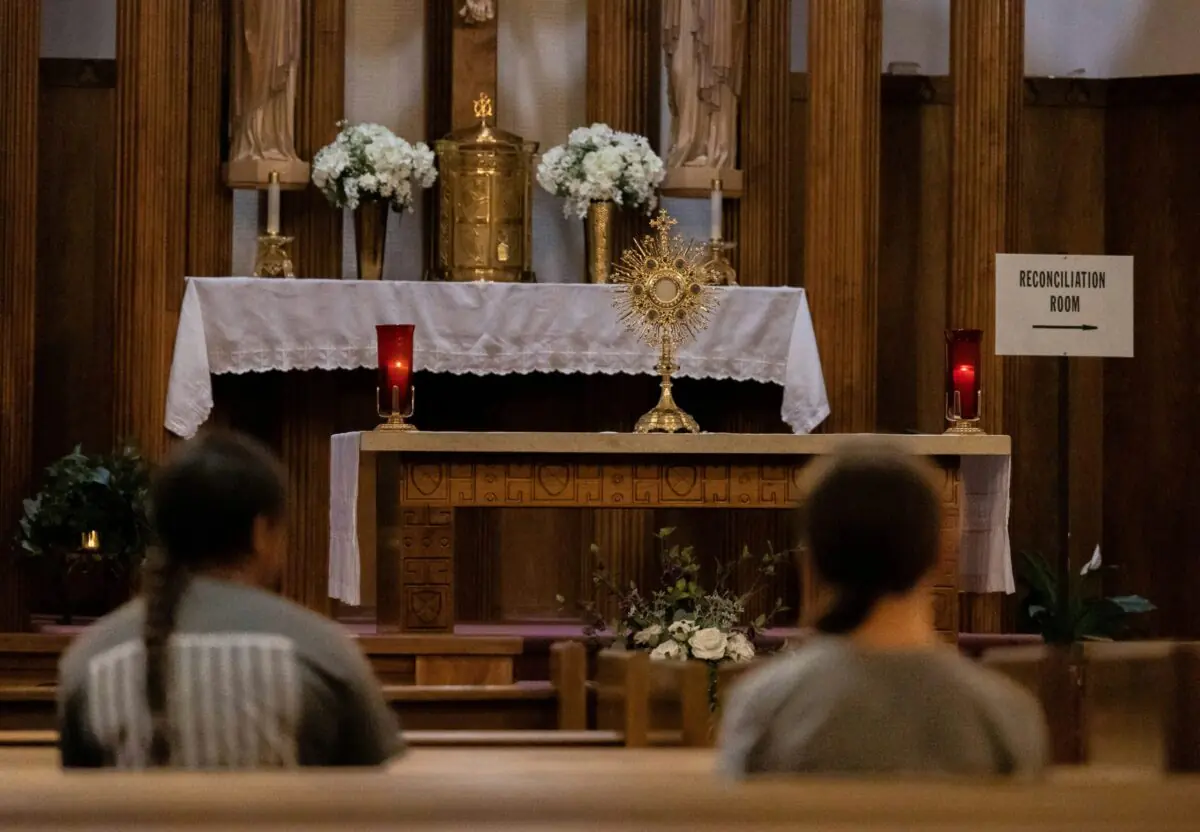
Image: Photo by Matea Gregg on Unsplash