Lila –a dreamer, an artist– reimagines reality in her afternoon of village encounters. As she moves about town, observing the world and the lives of others, she brings a twinkle, a fresh gaze, a splash of color and a wondering spirit.
Through these gifts, Lila transforms a sad landscape. She reconciles a feuding couple, befriends a lonely bachelor, restores to beauty a dilapidated street corner…
Through her artist’s lens, she re-envisions the dullness that meets the eye. I call it the medicine of art… but is this REAL medicine? Objectors will argue that, if Lila really wanted to make a difference, she’d get her head out of the clouds and become a doctor or nurse or social worker… then she’d really be making a difference in people’s lives.
LILA
Alas, even as we smile at this little video, our own inner cynic is liable to mutter, “yeah, yeah, but it’s a fantasy! It might be sweet, but it doesn’t MEAN anything. It’s just art. So what?”
“SO WHAT?” Here’s the answer: The lens of enchantment is a fundamentally Christian faculty.
As it happens, enchantment is like an endangered species in these post-modern times. But I would suggest that, to maintain our faith and to thrive as human beings, we must actively guard, protect, and nurture the human faculty of enchantment.
To be clear, enchantment is not exclusively, religiously Christian. It belongs to our human nature, so we can see it everywhere and in everyone, regardless of a person’s faith tradition (or lack thereof). The best fruits of Christian, Eastern, Jewish, Greek (or any other) civilizations are replete with man’s expressions of awe, wonder and the imagination. What happens when we ignore man’s longing for enchantment?
Modernity’s Malaise: “There is nothing either good or bad, but thinking makes it so.”
Hamlet, spokesman for the prison of the mind, expresses an existential angst that’s all too familiar to us, even some 400 years after Shakespeare put those famous words in his character’s mouth. Question Reality. But oh how we fail to realize that we see reality through the very lenses the world has given us!
Two false lenses on the world are predominant in our present moment, and they have eroded our sense of wonder:
1. The empirically scientific lens, (at least its most belligerent strain) presumes that our only means of viewing and discussing reality is by way of the scientific method, and by what can be measured, weighed, plotted on a graph, etc. This lens takes on various labels, including Materialism, Positivism, and Reductionism. It can also be referred to as the problem of “scientism.” (Mind you, the Catholic lens, by comparison, does embrace science, inquiry, and the empirical realm… just not to the exclusion of mystery and mysticism. Don’t let them tell you the Church is afraid of science!)
2. The nihilistic lens is sometimes more insidious, because most people don’t go so far as to name it and claim it. This is often the one we absorb from the culture without any awareness that we’re absorbing it… and it is both a cause and a logical end of what used to be referred to as “teenage angst.” (But it’s not just teenagers who suffer from the idea that life has no meaning. This false premise causes great harm to men and women of every age bracket.)
Yes, we live in times that are decidedly disenchanted.
I tip my hat in sincere gratitude for modern medicine, and for all the material goods and comforts gained via technology and innovation. But these goods are not the result of an either/or framework. When it comes to acknowledging the necessity of wonder, imagination, awe, … in short, the soul of man, the Catholic Both/And embraces a fullness, and it rejects false choices.
So What? Why Enchantment Matters:
You could say that as Christians, we have a distinct and pressing duty to cultivate the enchanted lens, both for our own sake and in our commission to be salt and light for the world (Matthew 5:13-16), for the sake of sharing our hope with those who are trapped in the prevailing nihilism or scientism.
In cultivating enchantment, the Christian can become the flickering, hopeful light in the world, even when he is not speaking directly about his religion. In so doing, he becomes another Lila… painting color back into tired landscapes and bringing healing to broken hearts.
And this is why fiction, poetry, music, cinema, the arts… these things should matter to the Christian. The Gospel is not an engineering blueprint or a balanced mathematical equation. It’s not even an argument, per se (even though we sometimes turn it into one)…
Living the Christian Life is a love story…
…and, after all, what is Love, if it is not ENCHANTMENT?
What are some of your favorite “enchanted resources”? Here are a few suggestions to get you started.
“Enchanted” Resources
Movies
It’s a Wonderful Life Amelie, Spirited Away, The Secret Garden, The NeverEnding Story and The Princess Bride.
Authors
J.R.R. Tolkien, C.S. Lewis, George MacDonald, G.K. Chesterton and Charles Dickens
Works of Fiction
The Wind in the Willows, by Kenneth Grahame; Les Miserables, by Victor Hugo.
Poetry
In Scripture: The Psalms (150 Psalms of the Old Testament); Epics: The Illiad, The Odyssey, The Aneid, John Keats and Gerard Manley Hopkins
*Amazon Affiliate links help our ministry at no additional cost to you! Thank you for your support.

- A Little Way, A Lifelong Friendship: St. Therese
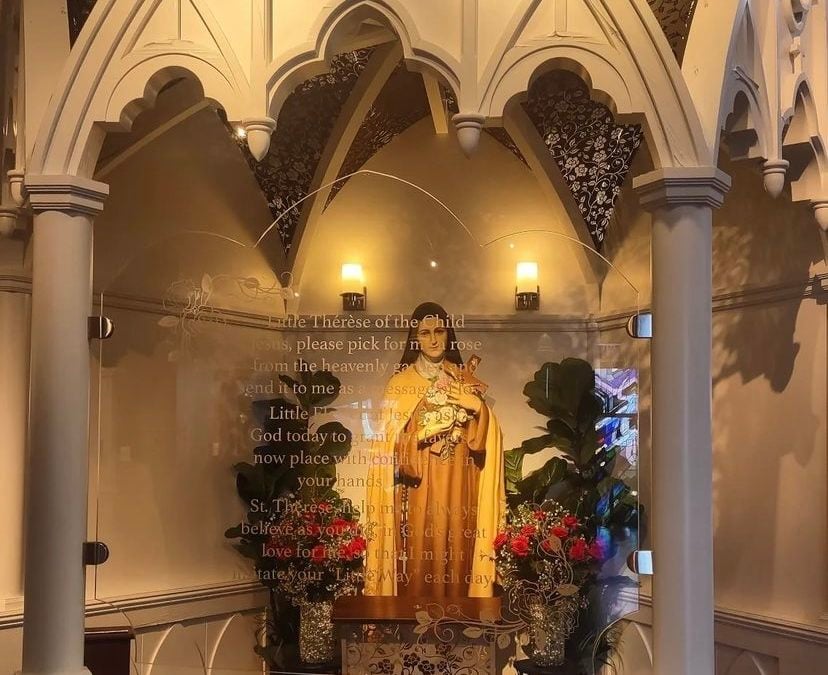
 Facebook Pinterest Gmail LinkedIn Print Friendly Sometimes a saint enters our lives quietly, long before we realize just how much she will mean to us. For me, that saint was St. Therese of Lisieux. I first discovered her in high school when my family visited the National Shrine Museum of St. Therese in Darien, Illinois.… Read more: A Little Way, A Lifelong Friendship: St. Therese
 - The Importance Of The Silence Of The Heart In Prayer
 Facebook Pinterest Gmail LinkedIn Print Friendly Saint Francis de Sales says that, just as bees return to the hive, attracted by the sweetness of honey, so the mystic soul loves to seek God within herself, knowing by experience how pleasant His company is. This image that Saint Francis describes has always mesmerized me. But who… Read more: The Importance Of The Silence Of The Heart In Prayer
 - How My Children’s Guardian Angels Help Me Parent
 Facebook Pinterest Gmail LinkedIn Print Friendly You and your children’s guardian angels When you hear the words ‘guardian angel’, what comes to mind? Often, when we think about angels, we picture a little cherub with rosy cheeks and soft wings, maybe playing the harp and lounging on a cloud. Harmless and pretty… but what if… Read more: How My Children’s Guardian Angels Help Me Parent
 - Hispanic Saints To Remember This Hispanic Heritage Month As We Celebrate The Universal Church
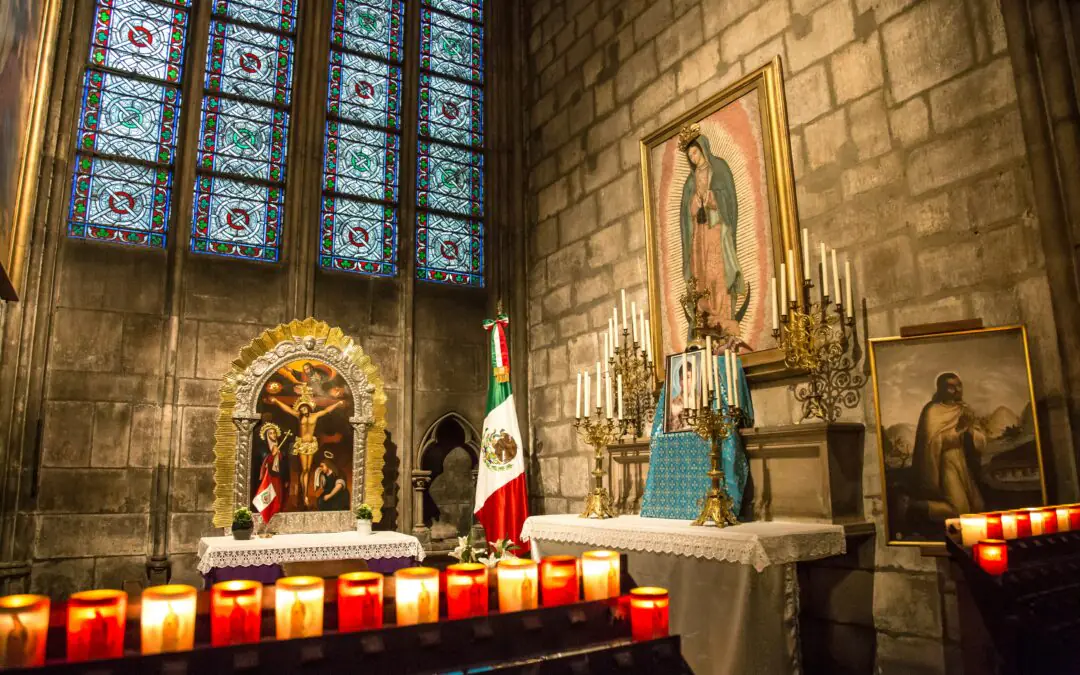
 Facebook Pinterest Gmail LinkedIn Print Friendly The word “catholic” comes from the Greek term katholikos, which means “universal” or “whole.” The beauty of the Catholic Church is that it encompasses people of all cultures and backgrounds. Every year, the United States celebrates Hispanic Heritage Month from September 15 – October 15. This month, we want… Read more: Hispanic Saints To Remember This Hispanic Heritage Month As We Celebrate The Universal Church
 - 4 Practical Ways To Share Your Faith
 Facebook Pinterest Gmail LinkedIn Print Friendly Jesus commanded us to “proclaim the gospel to every creature” (Mark 16:15). We hear that call, but have no idea what to do with it on a Tuesday afternoon. Evangelization causes us to picture the street preacher with a bullhorn, or the argument that ruined someone’s Thanksgiving, or the… Read more: 4 Practical Ways To Share Your Faith