The other day I had the opportunity to speak to a group of Italian youth. I asked how many of them believe in God. One responded saying, “I don’t believe in religion; rather, I believe in science.” I love this response because it is a typical, yet fertile starting point for speaking about the faith, religion, and God.
“I believe in science.” I couldn’t put it better myself. The attitude of belief and science not only are not opposed, rather, they go hand and hand.
Why? Because science often leads us to believe and accept as certain many truths that often seem to be everything but certain or evident according to our senses. Take a look at the table that your computer is resting upon. It looks pretty solid, correct? In reality, it is more like a cloud of united particles that is mostly empty.
Time and time again, science calls upon us to go against what seems most evident. What we perceive on a macro level constantly collides with how things appear on paper on a micro-level. There is a constant see-saw motion between grasping realities that go beyond our eyes, while, at the same time, letting go of our concepts in order to see what is beyond our reason.
To claim, then, that science is in itself opposed to the attitude of faith – faith being understood as an attitude of trust before that which cannot be proved or demonstrated – is not only ideological and lame, it contradicts the daily attitude that every scientist must have. No scientific truth was born without a hypothesis, an intuition of a faraway and unreached shore.
Likewise, no scientific “truth” is complete in the sense that nothing else can be said about it: new discoveries, paradigmatic shifts as Kuhn would say, occur constantly and challenge even the most “certain” scientific beliefs. Just as Christopher Columbus, knowing how to read the signs isn’t enough for a good scientist, he must have the courage to believe to make the journey. And, as any honest historian of science would say, this is a journey that never ends.
With today’s post and these quotes, we hope to offer you a great resource for presenting science not only as an exercise for those content with “certainty”, rather as an exercise for those who starve for the adventure of mystery and know that only in going beyond the comforts of such certainty can the deeper truths be reached.
The field of quantum mechanics is perhaps one of the most compelling and contemporary fields in this sense. Once we endeavor to understand things on such a minimal level, our models and imagination fall dreadfully short. This means that science and mystery come hand and hand. Let’s take a few quotes from some of the greatest protagonists of the field of quantum mechanics.
Quotes From Great Scientist On Faith
“For those who are not shocked when they first come across quantum theory cannot possibly have understood it. ” – Niels Bohr
“I think I can safely say that nobody understands quantum mechanics.” – Richard Feynman
“… the ‘paradox’ is only a conflict between reality and your feeling of what reality ‘ought to be” – Richard Feynman
-

- Faith and Science are Compatible

-

- Faith and Science are Compatible

-

- Faith and Science are Compatible

-

- Faith and Science are Compatible
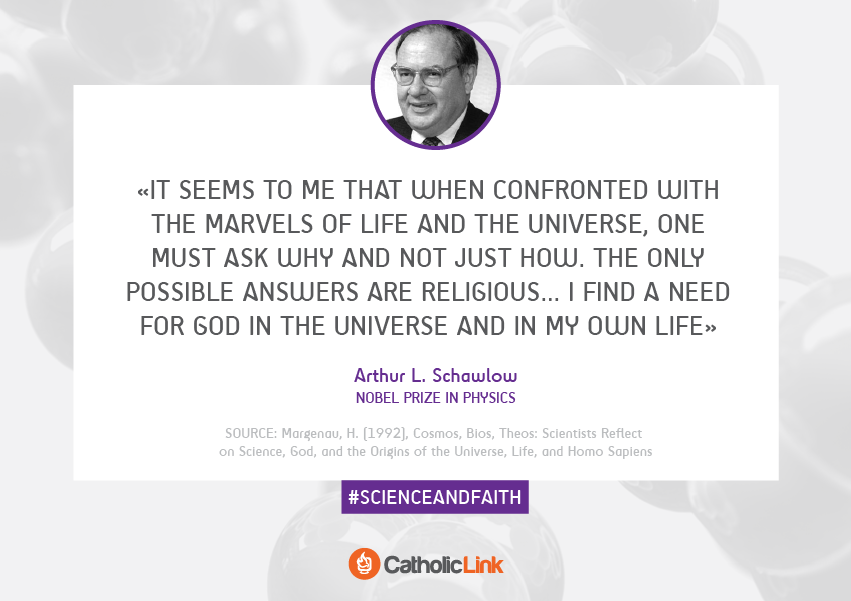
As we can see, a man of science is one that is fascinated and drawn to that which is mysterious. Only when we allow the demands of reality to draw us out of our comfortable, yet reductive constructs can we discover, contemplate, and celebrate reality in all of its splendor. Thus, the man of science, similar to the man of faith, aspires to the virtues of Abraham or Christopher Columbus, not Odysseus. While the latter embarked upon a journey only to return home, the likes of Christopher knew that their home could only be found in going “from your country” (Gen 12:1).
This with regards to the human attitude of faith; what can one say regarding the Christian faith? Let’s be clear, again, there is no contradiction. According to its proper principles, science assumes as its object that which is material and can be experientially verified or falsified. To ask science for proof of God’s existence or activity is to ask a question that goes intrinsically beyond the self-assumed boundaries of science. In favor of precision and certainty, the scientific mentality necessarily adopts a very reduced and limited vision of reality.
Thus, the moment that a scientist begins to offer “scientific” answers to the most essential questions for our lives (“Who am I?”; “Where do I come from?”; “Why does evil exist” “What follows this life?”) we must respond critically because, according to their categories, they have ceased to speak scientifically.
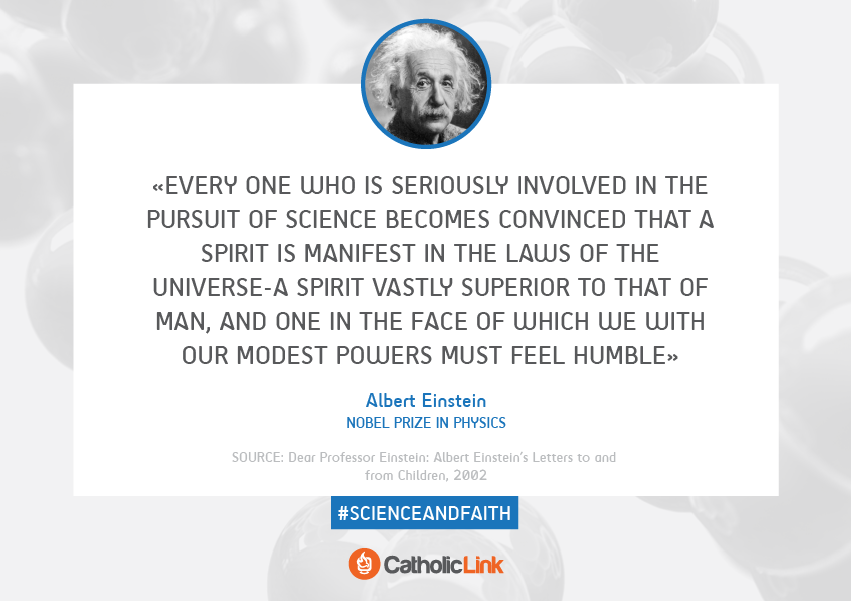
Quotes From Nobel Winning Scientists On Faith
-

- Faith and Science are Compatible

-

- Faith and Science are Compatible

-

- Faith and Science are Compatible
-

- Faith and Science are Compatible

-

- Faith and Science are Compatible

-

- Faith and Science are Compatible

The discoveries and instruments of science can most surely help us to answer these fundamental questions. Still, just as the technological inventions and astronomy allowed Christopher Columbus to go beyond, to immerse himself in the mystery and discover an unknown world, they fail to explain why he sought such a world. They fail to answer why he invents in the first place: what is it that pushes man beyond that which is evident, that which is immediate, that which is routine?
These are questions that find their answers only in the human heart, a heart made for a horizon that both illuminates our current patria while simultaneously inviting us to explore and search for another.
More Catholic Resources On Faith And Science