Many faithful Catholics quietly struggle with the question…“Is this healthy, or is this too much?”
On the surface, healthy Catholic spirituality and scrupulosity can look very similar. Both include prayer, regular examination of conscience, and a sincere desire to avoid sin. But beneath the surface, they are driven by very different forces.
One is rooted in truth and leads to peace. The other is driven by fear and leads to exhaustion.
Understanding this difference is not about labeling yourself. It is about gently realigning your life with how God designed your mind, body, and soul to function.
What Healthy Catholic Spirituality Looks Like
Healthy Catholic spirituality is grounded in truth, order, and relationship. It begins with a foundation that does not change: You are good. You are loved. You are enough. From that foundation, growth becomes possible.
A healthy spiritual life includes:
● Prayer that connects you to God, not pressures you.
● A desire to avoid sin, without constant fear of failure.
● Confession as a place of healing and clarity.
● Trust in God’s merciful grace, even when you fall.
There is structure, but it is ordered and calm. (When something is “ordered”, it means that it operates properly and functions as it ought to. The opposite of order is chaos.)
You examine your conscience, but you do not live trapped inside it. You strive for virtue, but you are not crushed by imperfection. You recognize sin, but you also recognize grace. The result is not perfection. The result is peace.
Even when life is difficult, there is an underlying stability: You are grounded. You are steady. You rest in Him, and are not constantly trying to “fix” yourself.
What Scrupulosity Looks Like
Scrupulosity often appears spiritual, but it is not rooted in peace. Scrupulosity is driven by fear, urgency, and the ever-present need for certainty.
For many people, scrupulosity is closely connected to Obsessive Compulsive Disorder (OCD or the tendencies toward compulsions), including:
● Intrusive thoughts that feel alarming or inappropriate.
● Repetitive checking (“Was that a sin?” “Did I mean that?”)
● Compulsions around confession or prayer.
Instead of leading you toward God, scrupulosity pulls you inward into constant analysis. You may notice:
● Replaying situations over and over, trying to be sure you didn’t sin.
● Feeling pressure to confess repeatedly or with excessive detail.
● Questioning normal daily actions.
● Feeling like you can never quite “land” in peace.
● Pressuring yourself to be perfect, in a self-savior type of mentality.
Healthy spirituality is clear and direct. Scrupulosity is repetitive and unresolved. God’s voice is steady. Scrupulosity is loud.
The Core Difference: Truth vs. Fear
Healthy Spirituality Scrupulosity
Rooted in truth. Rooted in fear.
Clear and grounded. Confusing and repetitive.
Leads to peace. Leads to anxiety.
Allows imperfection. Demands certainty.
Builds trust in God. Keeps focus on self.
God does not operate from a place of confusion. He created your mind and body to function in order. When something feels chaotic, repetitive, and unresolved, it is a signal – not of failure – but a sign to reach for realignment.
Why This Happens
Scrupulosity is not simply a spiritual issue. It involves the biology of anxiety.
When your nervous system is activated, your brain searches for certainty. It overestimates danger and struggles to feel “finished.” This is where OCD patterns attach to faith. Your brain is trying to protect you, but it is misinterpreting the situation. This is why increasing prayer or confession alone does not resolve scrupulosity. Without addressing the nervous system, the cycle continues. God created both your soul and your body. Healing requires caring for both.
What God Is Actually Asking of You
God is not asking you to feel certain all the time. He is asking for something deeper: Trust. Surrender. Relationship. God’s design is not built on pressure, but is built on truth. And truth is steady.
5 Signs Your Spirituality May Be Moving Toward Scrupulosity
1. You repeatedly question whether you have sinned in ordinary situations.
Your mind does not settle, even after reflection.
2. You feel a strong urge to confess the same sins multiple times.
Confession becomes driven by anxiety rather than clarity.
3. Your prayer feels pressured or urgent.
It feels like something you must “get right,” rather than a place of connection.
4. You struggle to accept forgiveness after confession.
You feel the need to revisit or confirm again.
5. Your anxiety increases as you try to be more spiritually perfect.
Instead of peace, your effort leads to more tension.
5 Steps Back to Healthy Catholic Spirituality
1. Commit to one regular confessor.
Consistency creates clarity. Moving from priest to priest feeds confusion. Choose one and trust the guidance you are given.
2. Do not re-confess doubtful sins.
If you are unsure, treat it as resolved. This corrects the pattern of over-analysis.
3. Set limits on examination of conscience.
Give yourself a clear structure (5–10 minutes). When time is finished, you stop.
4. Allow uncertainty without trying to fix it.
You will not feel completely certain. The goal is stability, not certainty. Trust in God’s grace – He gives it, so simply receive!
5. Return to simple, grounded prayer.
Speak to God directly. Keep it clear and calm. You are not performing, you are relating.
Final Thoughts
Healthy Catholic spirituality is stable, grounded in God’s Grace, and leads to peace. Scrupulosity is reactive, repetitive, and keeps you unsettled. If your spiritual life feels heavy or exhausting, that is important information. Return to what is true: You are good. You are loved. You are enough.
God is asking for your trust. And trust, built over time, restores both peace and order. He is a loving father who guides us through life, not a bully or tyrant wanting to condemn us. “For the Father Himself loves you.” (John 16:27)
Keep Learning:
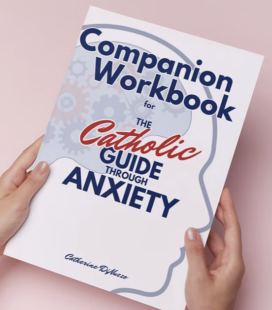
The Catholic Guide Through Anxiety: Sacred Heart Mental Wellness, with Foreword by Fr. John Paul Mary Zeller, MFVA (Catholic Mental Wellness) is an easy-to-read 155-page book is purposefully designed and spaced to make it easy for the anxious person, a dyslexic person (like the book’s author, Catherine!), slow readers, or readers who want to spend additional time with the material in thought, journaling, prayer, small groups, spiritual direction, or therapy sessions.
No, you’re not crazy! Anxiety is a natural response of the body. AND… God gave it to us as a gift to keep us safe! By the end of the book, you’ll be thanking God for your anxiety.
This guide aims to help you work through and ultimately understand anxiety from a Catholic perspective. Please be assured that you don’t need to be a Catholic to read this; there’s fantastic information for everyone. However, please be aware that there are thoughts, prayers, imagery, strategies, and sentiments that are innately and traditionally Catholic.
This book will help you understand and overcome your anxiety, AND it will also help those wanting to learn how to help loved ones who struggle with anxiety. This guide is ideal for readers of all ages, including children, teenagers, and college students. And, we believe that learning this information and implementing these practices may help decrease suicide, suicidal tendencies/ideations, as well as self-harm and self-abuse.
Purchase HERE!

6 Things That Happen When You Go To Confession
Facebook Pinterest Gmail LinkedIn Print Friendly The spiritual effects of the Sacrament of Penance are: 1. Reconciliation with God by which the penitent recovers grace; 2. Reconciliation with the Church; 3. Remission of the eternal punishment incurred by mortal sins; 4. Remission, at least in part, of temporal punishments resulting from sin; 5. Peace and […]

3 Things To Do When You Mess Up According To A Saint
Facebook Pinterest Gmail LinkedIn Print Friendly Three Things To Do When You Mess “God wishes us to be meek even toward ourselves. When a person commits a fault, God certainly wishes him to humble himself, to be sorry for his sin, and to purpose never to fall into it again; but he does not wish […]

Be Ashamed When You Sin, Not When You Repent | St. John Chrysostom
Facebook Pinterest Gmail LinkedIn Print Friendly Be ashamed when you sin, not when you repent. – St. John Chrysostom Subscribe To Our Weekly Newsletter!Our weekly email newsletter includes links to our seasonal content so you can stay connected to the Church’s liturgical seasons and find simple ways to celebrate them and grow in holiness. SUBSCRIBE! […]

5 Things Even Devout Catholics Can Do To Go Deeper In Discipleship
Facebook Pinterest Gmail LinkedIn Print Friendly As Catholics, we have a desire to know the Lord, to deepen our relationship with God. To somehow invite Jesus Christ, who pursues us each personally, into every part of our lives. I give you a new commandment: love one another. As I have loved you, so you also […]

God’s Mercy Is Endless | Catholic-Link.org
Facebook Pinterest Gmail LinkedIn Print Friendly God’s Mercy Is Endless More Catholic Resources How To Pray The Divine Mercy Chaplet: Your Step By Step Visual Guide How To Pray Lectio Divina? A Visual Step By Step Guide The Blessed Sacrament: Step-by-Step Visual Guide To Adoration A 7 Step Visual Guide For Going To Confession […]
Image: Photo by BĀBI on Unsplash