Jesus said to his disciples:
“The person who is trustworthy in very small matters
is also trustworthy in great ones;
and the person who is dishonest in very small matters
is also dishonest in great ones.
If, therefore, you are not trustworthy with dishonest wealth,
who will trust you with true wealth?
If you are not trustworthy with what belongs to another,
who will give you what is yours?
No servant can serve two masters.
He will either hate one and love the other,
or be devoted to one and despise the other.
You cannot serve both God and mammon.”-Luke 16:10-13
Prudent Stewards
The steward in today’s Gospel confronts the reality that he can’t go on living the way he has been. He is under judgment, and he must give account for what he has done. The exploiters of the poor in today’s First Reading are also about to be pulled down, thrust from their stations (see Isaiah 22:19). Servants of mammon, or money, they’re so in love with wealth that they reduce the poor to objects, despising the new moons and sabbaths—the observances and holy days of God (see Leviticus 23:24; Exodus 20:8).
Their only hope is to follow the steward’s path. To be clear, he is no model of repentance. But he makes a prudent calculation: he uses his last hours in charge of his master’s property to show mercy to others, relieving their debts. He is one of the “children of this world,” driven by a purely selfish motive—to make friends and be welcomed into the homes of his master’s debtors. Yet, his prudence is commended as an example to us, the “children of light” (1 Thessalonians 5:5; Ephesians 5:8).
We must realize, as the steward does, that what we have is not honestly ours but in truth belongs to another, our Master. All the mammon in the world could not have paid the debt we owe Him. So He paid it for us, giving His life “as a ransom for all,” as we hear in today’s Epistle.
God wants everyone to be saved—even kings and princes, even the lovers of money (see Luke 16:14). But we cannot serve two masters. By His grace, we should choose to be, as we sing in today’s Psalm, “servants of the Lord. We serve Him faithfully by using that with which He has entrusted us to give alms, to “[raise] up the lowly from the dust” and “dunghills” of this world. By this we will gain what is ours; we will be welcomed into eternal dwellings, the many mansions of the Father’s house (see John 14:2).
Why choose to serve God? Because He is greater than anyone or anything we could serve, consciously or otherwise. It’s good to remind ourselves occasionally of the awesomeness of God. God alone created the universe freely, directly, and without any help. (CCC 317)
A person who is not trustworthy with another’s wealth uses it improperly. God has revealed that these misused resources must be repaid. It’s not enough to apologize; a person who steals must make every reasonable effort to repair the damage that he or she has inflicted. Every manner of taking and using another’s property unjustly is contrary to the seventh commandment. The injustice committed requires reparation. Commutative justice requires the restitution of stolen goods. (CCC 2454)
Reflect
What are some tangible ways I can shift my priorities to serve God?
To whom might I owe reparation, be it financial, emotional, or otherwise?
Pray
St. Louis IX, as you had access to great wealth and used it for great good as the king of France, pray that always give money its proper role in my life. May I not love money but instead acknowledge it as a means to many ends. Pray for my discernment and prudence, that I may use whatever money I have in ways pleasing to God. Amen

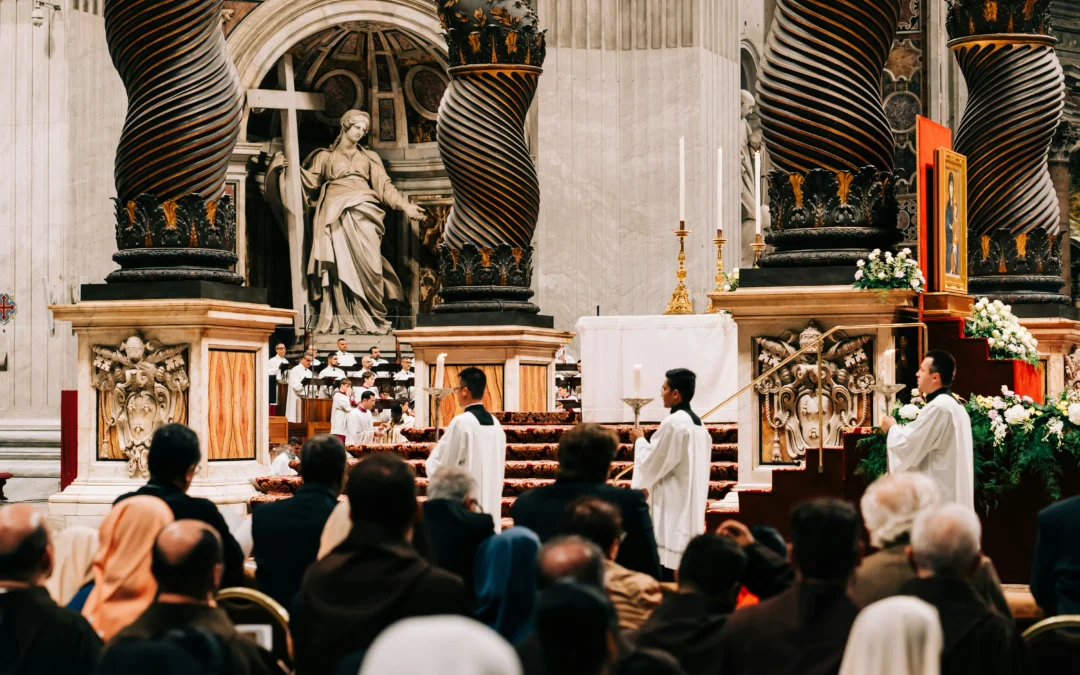
Image: Photo by Alexander Grey on Unsplash