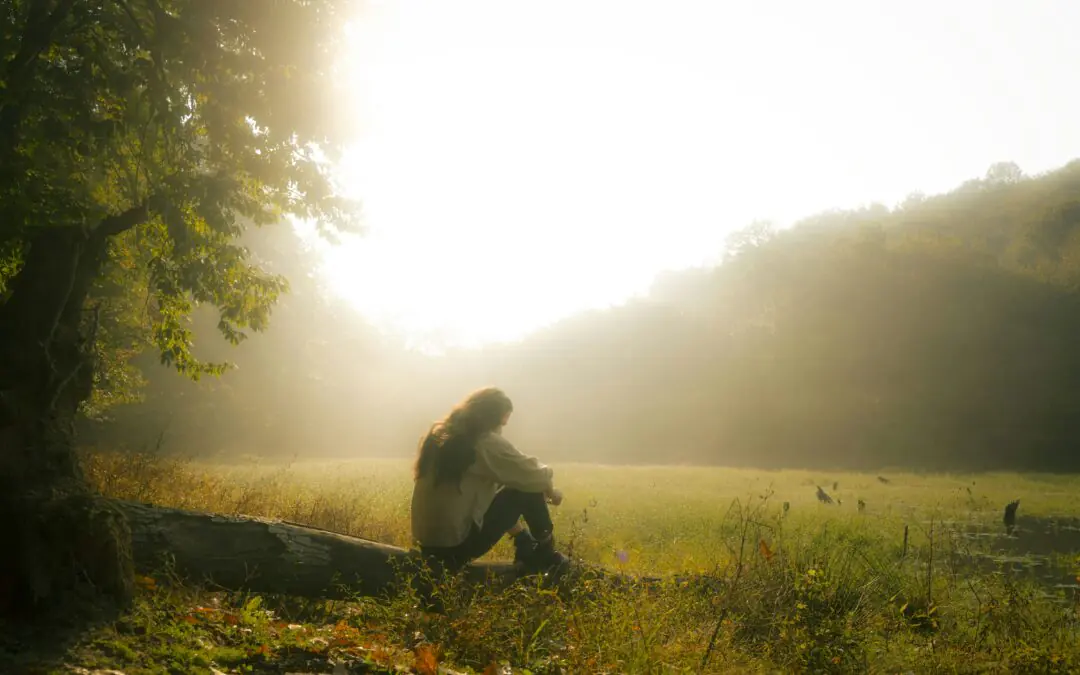
“He lost himself in dreams of what could have been had he just left; left without saying anything; left forever, without ever returning home again.” ~ Pirandello
Who among us has not felt the urge to just run away and leave everything? This was the case with Mr. Bareggi, the protagonist in Luigi Pirandello’s novel entitled “Escape.” He jumped on the milkman’s horse and rode madly over the horizon only to be eventually thrown from the horse, at which point he finally realizes that his foolishness was driving him towards nothingness.
Perhaps this is the reason for Jesus’s passionate appeal to remain in Him, expressed in this passage of the Gospel. It makes me think that even the first Christian community must have suffered from this desire to just run away from everything.
We feel the need to flee when we are disappointed, when we see that things are not going the way we’d hoped. We want to leave when we feel excluded, when we feel we have nothing left to give. We want to break away when we’re angry, when we are faced with injustice.
Our age, like that in which Jesus lived, offers many reasons to leave: political confusion, the arrogance of power, intolerance in relationships, the incapacity of those in charge to listen to and value those they serve…
We live in a time when the Holy Spirit seems to have drawn back from the world. When I pray, I often return to an image: it’s as if Jesus has left me with the tools and has distanced Himself again.
In this Easter season, even Luke the Evangelist presents us with this experience of disappointment and fleeing: the two disciples of Emmaus, three days later, after having realized that things didn’t go according to their expectations, decided to leave.
When we are hit with deception and anger, we are pushed to break off all of our relationships without even realizing whom we are leaving behind. Looking closely, Jesus’s invitation is not an appeal to be passive but to remain connected. Love has nothing to do with the stubbornness of remaining unchanged but requires the openness that allows the sap to flow from vine to branches. The branch can also appear to be attached to the vine, yet still not allow the sap to flow.
Jesus does not invite us to remain in a stubborn and headstrong passivity but invites us to remain in Him and to let Him remain in us. Jesus invites us to remain in a relationship: “without me you can do nothing.” Pushing the Latin translation a little further, J. Martain translated this expression as “without me you can do nothingness.” Without Jesus, our lives are caught up in a vortex of senselessness that we can only strive uselessly to fill.
What is certain is that life must also undergo pruning. Jesus does not deceive us by telling us that we will undergo a painless blossoming. Looking back on our own personal histories, we can see how moments of suffering and pain we have helped us grow. We live in a culture that refuses any type of pruning, any suffering, and that is why the younger generations are in danger of not blossoming at all. The adults, parents and educators, often fear the work of pruning. Blossoming only occurs after a period of bareness in which the plant appears helpless. But without pruning, the plant weakens and the risk is this: we are forming a generation of men and women that are fragile, that will be crushed under the weight of life.
Perhaps the Vine Grower, moved to pity by this grievous vineyard, will come and give us a hand!
Questions for personal reflection:
- What are the things in your life that drive you to run away from reality?
- In what ways might the the Lord be pruning you so that you can bear good fruit?
A reading from the holy Gospel according to John (15:1-8)
Jesus said to his disciples: “I am the true vine, and my Father is the vine grower. He takes away every branch in me that does not bear fruit, and every one that does he prunes so that it bears more fruit. You are already pruned because of the word that I spoke to you. Remain in me, as I remain in you. Just as a branch cannot bear fruit on its own unless it remains on the vine, so neither can you unless you remain in me. I am the vine, you are the branches. Whoever remains in me and I in him will bear much fruit, because without me you can do nothing. Anyone who does not remain in me will be thrown out like a branch and wither; people will gather them and throw them into a fire and they will be burned. If you remain in me and my words remain in you, ask for whatever you want and it will be done for you. By this is my Father glorified, that you bear much fruit and become my disciples.”
The Gospel of the Lord
Photo credit: SHINE TANG / Unsplash
More Catholic Bible Study Resources