Many times when I get bored at Mass, it is because I didn’t prepare myself well beforehand. Or I might have had too many worries floating around in my head that I was unwilling to entrust to God. I think it would be safe to say that the readings of the genealogies (Matthew 1 and Luke 3:23-38) in the Gospels present a special challenge.
It’s tough not to get distracted. Trying to find some meaning that applies to our lives seems impossible.
Still, all is not lost. As usual, the Word of God always surpasses our skeptical expectations. Here are a few surprisingly powerful ways this Gospel reading (Mt 1:1-16, 18-23) spoke to me:
1. Patience measures and inflames desire
I’m not sure how many Russian movies you have seen, but the first one that I saw was one by Andrei Tarkovsky called the Stalker. The movie’s introduction is undoubtedly the slowest that I’ve ever seen. The first three to four minutes are packed with scrolling credits and an immobile man drinking a cup of coffee. From there, things get more interesting if you’re able to pick up on the symbols.
Speaking about it in an interview, Tarkovsky said something surprising:
“The film needs to be slower and duller at the start so that the viewers who walked into the wrong theatre have time to leave before the main action starts”.
I sometimes wonder if, in addition to the many theological and historical themes present, the Gospel writer wants to see what kind of audience he has. Waiting tests and increases the desire. How big is our desire to hear the good news? How strong is our perseverance? He wants to know if we’re there for the right reason.
**It’s worth noting that with study, one will stumble on plenty of interesting facts and dimensions in these genealogies. Even their structure and placement reveal certain ideas and conceptions of the Gospel writer. But I will leave that for another post.
2. A powerful dramatic technique
While some might imagine a historian writing it, what if the Gospel writer was something more like a theater director. What if he was actually implementing a powerful, dramatic technique?
You probably waited between two and three minutes for the genealogy to be read. Have you ever asked yourself: How long has mankind waited for the coming of God, the Emmanuel? What if the genealogy gives us a minuscule taste of that century-long wait?
The revelation of who God is, of His love and mercy, did not happen overnight. Each name on that long list has a story to tell. Many were serious sinners, men and women who fell time and time again. They struggled to discover and remain faithful to both God and themselves.
Maybe the Gospel writer is subtly telling us something similar. We all need to be patient and persevere in order to discover who God is in our lives, just like the people of Israel. There are so many questions that one might have about his or her faith, about the teachings of the Church. We all doubt once in a while whether we are capable and willing to live out the Christian adventure at all. Today’s Gospel reminds us that it takes time and perseverance. More than a spotless record, those who reached the promise land of Emmanuel were those who trusted in Him and moved forward, one day at a time.
3. Patience doesn’t only mean waiting
Patient, coming from its Latin root, also refers to suffering. And just as the people of God and the people of Israel waited, they also suffered. We read of the exportation and Babylon. As the plight of so many refuges in the world reminds us, nothing could be more dramatic or more tragic for these people.
Yesterday’s Gospel reminds us that we must be willing to take that difficult road. We all have a road. No one else can walk it for us. Every road implies suffering and brings with it different kind of tragedies, kind of exiles in our life.
Nevertheless, we can all be sure of one thing: if our heart is in the right place, that road leads us to where we want to go. It leads us to Christ.
4. How do you read your story?
When you look back at your life, don’t you wish you could erase a few sins? Avoid a few mistakes? Take advantage and appreciate certain moments? In his letter to the Romans – a reading that at times accompanies the reading of the genealogy in Matthew – Paul reminds us – Brothers and sisters: “We know that all things work for good for those who love God, who are called according to His purpose” (Rm 8: 28).
Remember that the list of names in the genealogy is full of sinners. They were men and women that screwed up… a lot. Yet, somehow, by God’s providence, they all lead in one direction: the coming of Jesus Christ. We should apply this truth to our own lives and how we read our own stories. Try to take a step back and ask God for the grace to see your life as He sees it. Try to discover how in both your weakness and your strengths, in the tragedies and the triumphs, God has been present, leading you closer and closer to His son.
Subscribe To Our Weekly Newsletter!
Our weekly email newsletter includes links to our seasonal content so you can stay connected to the Church’s liturgical seasons and find simple ways to celebrate them and grow in holiness.
Catholic-Link.org is committed to publishing articles and images free from the use of AI. We believe that writing and art should come from the heart of a human soul in order to fully express the truth, beauty, and goodness of God. The Holy Spirit is the divine...
Adore Him: He is Here is a new docudrama hitting U.S. theaters Oct. 4-8. Executive Producer Deacon Steve Greco. Hear powerful testimonies about the transforming power of Eucharistic Adoration from renowned Catholics such as Mark Hart, Chris Stefanick, Dan DeMatte,...
Saint Francis of Assisi is cherished by Christians across many traditions. As we approach his feast day on October 4, we celebrate 800 years since his death, which he lovingly called Sister Death. Although I am a Benedictine at heart, Francis holds a special place in...
Saint Theodore Guerin was a French nun who worked tirelessly to educate and care for the poor and sick. St. Theodore Guerin: 5 Things To Know About Her The ocean brought Saint Theodore to God. While looking at the vastness of the ocean, Saint Theodore found herself...
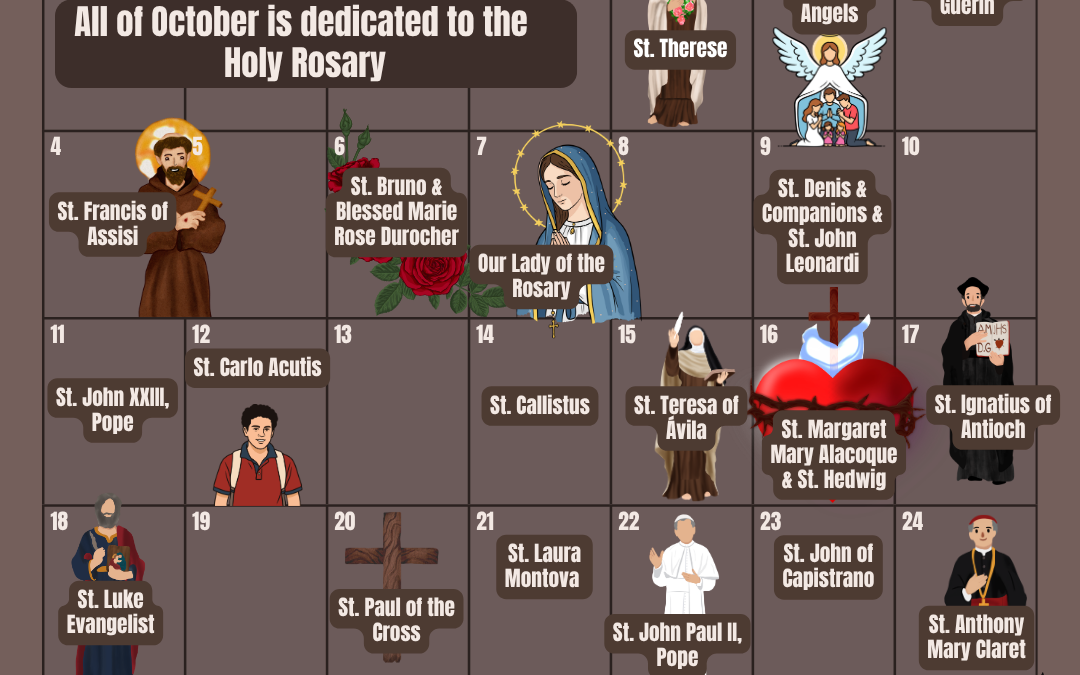
October 1: St. Therese of the Child Jesus October 2: Guardian AngelsOctober 3: St. TheodoreOctober 4: St. Francis of AssisiOctober 5: St. FaustinaOctober 6: St. Bruno, Blessed Marie-Rose DuroherOctober 7: Our Lady of the RosaryOctober 9: St. Denis and companions, St....
Jesus said to the chief priests and the elders of the people:"Hear another parable.There was a landowner who planted a vineyard,put a hedge around it, dug a wine press in it, and built a tower.Then he leased it to tenants and went on a journey.When vintage time drew...
Sometimes a saint enters our lives quietly, long before we realize just how much she will mean to us. For me, that saint was St. Therese of Lisieux. I first discovered her in high school when my family visited the National Shrine Museum of St. Therese in Darien,...
Saint Francis de Sales says that, just as bees return to the hive, attracted by the sweetness of honey, so the mystic soul loves to seek God within herself, knowing by experience how pleasant His company is. This image that Saint Francis describes...
You and your children’s guardian angels When you hear the words ‘guardian angel’, what comes to mind? Often, when we think about angels, we picture a little cherub with rosy cheeks and soft wings, maybe playing the harp and lounging on a cloud. Harmless and pretty…...
The word “catholic” comes from the Greek term katholikos, which means "universal" or "whole.” The beauty of the Catholic Church is that it encompasses people of all cultures and backgrounds. Every year, the United States celebrates Hispanic Heritage Month from...
Jesus commanded us to "proclaim the gospel to every creature" (Mark 16:15). We hear that call, but have no idea what to do with it on a Tuesday afternoon. Evangelization causes us to picture the street preacher with a bullhorn, or the argument that ruined someone's...
Born in Texas, I spent 12 years living and working in Peru and Italy. A philosopher and a theologian, I have a passion for the power of stories in our lives.
Subscribe To Our WeeklyEmail!
Join our mailing list to receive the latest articles, updates, and seasonal Catholic content from Catholic-Link.org!