It’s what I get for writing a book titled Talking of Michelangelo: Death, Judgment, Heaven and Hell in the Burgundy Region. Interviewers are constantly asking me about Michelangelo and his painting The Last Judgment, which graces the cover of my book. It’s gotten me thinking more and more about the painting and pondering this monumental human achievement, not just artistically, but theologically. It’s an extremely rich source of meditation and prayer.
Michelangelo’s The Last Judgment
Themes From The Last Judgment
A complete analysis of the painting would fill an entire book, of course, but what I propose here is to share several themes in the painting which have inspired me and enriched my understanding of the last judgment.
- Judgement
Okay, it’s not death or taxes, but the last judgment is one of those inescapable things we will all have to face. It’s not for nothing that we call it the last judgment, because we are all subject to judgments every day, especially if you live with teenagers or look at the news. Someone’s always to blame. Everything is someone’s fault. The consequences are always dire and apocalyptic — even if it’s just that someone took the last soda can out of the pantry.
But all of these little judgments we live with every day can be reminders that “Heaven is above all yet; there sits a judge that no king can corrupt,” as Shakespeare would say. That’s important to remember. When we settle the little disputes we engage in every day, whether it be over the family pantry, national politics, or legal battles we wage in court at great expense, even when we deem these to be over, and someone has won, and someone has lost — it’s not over. For heaven is above all yet. Christ has not yet returned. The world is still intact. The final judgment has yet to be rendered.
- The End of the World
But a day will come when Christ does return to render final judgment; then a truly just and perfect judge will hand down an opinion that will be final and eternal. On that frightful day, everything will hang in the balance.
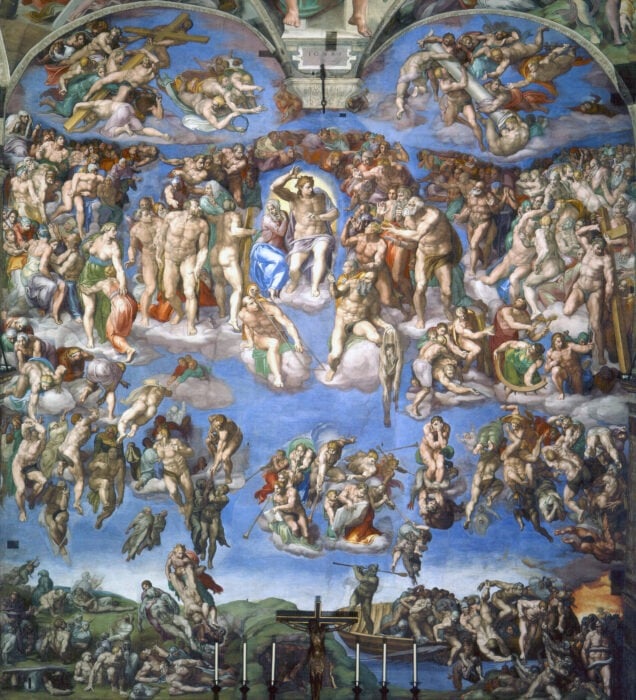
Appreciate what you’re looking at when you ponder Michelangelo’s The Last Judgment. This is not a moment in time; it is the end of time. One striking reminder in the painting is St. Peter, to the right of Christ, handing Christ back the keys to the Kingdom of Heaven. I never thought about the fact that after the last judgment, there would be no more Church on earth. Peter no longer holds the keys. A nice reminder for all the popes who say Mass under this painting.
Another detail on this topic is the seven trumpets. In the cluster of angels in the center below Jesus’ feet, there are seven angels blowing seven trumpets. If you’ve ever heard Handel’s Messiah, you know that beautiful bass-baritone voice singing, “The trumpet shall sound!” Well, there it is, and someday, that will really happen.
- The Element of Surprise
Michelangelo’s depiction of the Last Judgment was a departure from previous paintings, which showed at least the upper regions of heaven and the saved souls in an orderly fashion, while there might be some confusion among the damned. But for Michelangelo, the entire scene is chaos. Take a step back and look at it. While there is definitely some horizontal banding, there’s a confused, chaotic feel to the entire painting, all the way up to the lunettes at the very top where the angels display the instruments of Christ’s torture by which he gained heaven for believers.
I think this is a result of Michelangelo’s decision to depict the very first moment of the Last Judgment. Christ has just raised his hand; his mother looks away, unable to bear it. The trumpets are sounding. Angels and demons are already beginning the process of sorting the sheep from the goats. I think it’s safe to say that that moment will not be orderly. I mean, if the process of sorting people out so they can board an airplane brings out the worst in us, imagine this.
You can tell people are caught off guard, starting with the damned soul immediately to the right of the angels blowing trumpets. He holds his head in his hand as the realization hits him that he is damned. Two demons have already begun the process of dragging him down to hell.
But even the saints are acting as if they are caught off guard. They are all looking to Christ expectantly — is it I, Lord? Will I be with you in paradise? Many of the saints are holding out to Christ the instruments of their martyrdom as if to say, “See, I suffered this for you!” What will I have to show Christ at that moment?
- Dawn or Dusk
Michelangelo, like all Renaissance artists, was a master with the use of light. Which makes this painting so strange. There’s no single source of light for the whole of it. There are three distinct elements of light in the painting. First is the halo of sunshine that encompasses Christ and his mother only. Since they are not being judged, they are not in the twilit sky that all of creation is subject to at this moment. The other distinct source of light is the furnaces of hell down in the bottom right-hand corner.
But the main source of light is the brightness on the horizon that is either a sunset or a sunrise. It’s impossible to tell which it is, because, I suppose, it is meant to be both. For the saved it is the sunrise of eternity, and for the damned it is the sunset of all that is good.
- The Narrow Gate
The most striking part of this painting for me is always the two angels below the trumpeters holding the Book of Life and the Book of the Damned. You can’t miss the fact that the Book of the Damned is huge. It’s like the National Geographic Atlas of the World, while the Book of Life is like a little day planner. Clearly there are many more names in the Book of the Damned. This should give us pause.
This article only scratches the surface of this beautiful painting. Let us know in the comments if you’d like to read further reflections on Michelangelo’s The Last Judgment.
By Michelangelo – See below., Public Domain, https://commons.wikimedia.org/w/index.php?curid=16143987