Jesus proposed another parable to the crowds, saying:
“The kingdom of heaven may be likened
to a man who sowed good seed in his field.
While everyone was asleep his enemy came
and sowed weeds all through the wheat, and then went off.
When the crop grew and bore fruit, the weeds appeared as well.
The slaves of the householder came to him and said,
‘Master, did you not sow good seed in your field?
Where have the weeds come from?’
He answered, ‘An enemy has done this.’
His slaves said to him,
‘Do you want us to go and pull them up?’
He replied, ‘No, if you pull up the weeds
you might uproot the wheat along with them.
Let them grow together until harvest;
then at harvest time I will say to the harvesters,
“First collect the weeds and tie them in bundles for burning;
but gather the wheat into my barn.”‘”He proposed another parable to them.
“The kingdom of heaven is like a mustard seed
that a person took and sowed in a field.
It is the smallest of all the seeds,
yet when full-grown it is the largest of plants.
It becomes a large bush,
and the ‘birds of the sky come and dwell in its branches.'”He spoke to them another parable.
“The kingdom of heaven is like yeast
that a woman took and mixed with three measures of wheat flour
until the whole batch was leavened.”All these things Jesus spoke to the crowds in parables.
He spoke to them only in parables,
to fulfill what had been said through the prophet:
I will open my mouth in parables,
I will announce what has lain hidden from the foundation
of the world.Then, dismissing the crowds, he went into the house.
His disciples approached him and said,
“Explain to us the parable of the weeds in the field.”
He said in reply, “He who sows good seed is the Son of Man,
the field is the world, the good seed the children of the kingdom.
The weeds are the children of the evil one,
and the enemy who sows them is the devil.
The harvest is the end of the age, and the harvesters are angels.
Just as weeds are collected and burned up with fire,
so will it be at the end of the age.
The Son of Man will send his angels,
and they will collect out of his kingdom
all who cause others to sin and all evildoers.
They will throw them into the fiery furnace,
where there will be wailing and grinding of teeth.
Then the righteous will shine like the sun
in the kingdom of their Father.
Whoever has ears ought to hear.”
The Liturgy of the Mass is the Best Evidence of God’s Loving Patience
Today’s First Reading (Wisdom 12:13, 16–19) is taken from a larger homily in the Book of Wisdom that begins in Wisdom 11:6 and concludes in 19:12. The introduction to this homily (Wisdom 11:1) presents a narrative illustrating how the enemies of Israel—such as the Egyptians and the Canaanites—were punished during the Exodus, yet ultimately benefited from God’s mercy.
Biblical scholar Addison G. Wright, in The Structure of the Book of Wisdom, describes this section as consisting of “Five Antithetical Diptychs.”
The second of these antithetical diptychs, “Quail Instead of the Plague of Little Animals,” includes today’s reading. Here, the author explains that God’s justice and mercy toward Israel’s enemies arise from the fact that His omnipotence is always exercised with mercy.
Wisdom proclaims:
“For your might is the source of justice; your mastery over all things makes you lenient to all. For you demonstrate your might when the integrity of your power is disbelieved; and in those who recognize you, you rebuke arrogance. Yet, although you are master of might, you judge with clemency, and with great mercy, you govern us; for whenever you will, power accompanies you. Moreover, you have taught your people, through these deeds, that those who are just must be kind; and you have provided your children with a solid hope that repentance for their sins will be permitted.” (Wisdom 12:16–19)
This passage follows Wisdom 11:17–12:8, where the author emphasizes that God is merciful because He loves.
In its own way, the liturgy of the Mass functions like a diptych—an unfolding illustration. On one side, it portrays the faithful being prepared to receive Christ. On the other, it depicts the community living in communion with Him. The bond that unites these two images is the love of God.
Likewise, the homily in Wisdom teaches that God’s justice is always tempered by patience. His mercy, goodness, and gentle justice are revealed gradually because we are spiritually wounded and often inclined toward rebellion against Him. Yet through continual encounters with His presence, patience, and love, we are slowly transformed.
Just as the Apostle Paul teaches that love is patient, so too is the love of the Father. The Holy Spirit is likewise patient with our weakness, searching the depths of our hearts and drawing us back to God.
In today’s Second Reading (Romans 8:26–27), St. Paul writes:
“The Spirit comes to the aid of our weakness; for we do not know how to pray as we ought, but the Spirit himself intercedes with inexpressible groanings. And the one who searches hearts knows what is the intention of the Spirit because he intercedes for the holy ones according to God’s will.”
Knowing that we are wounded and often unable to pray as we should, the Holy Spirit places words on our lips, confessions on our tongues, and songs in our hearts, leading us to seek God’s mercy, justice, and healing.
If the Church—the Temple of the Holy Spirit—teaches us how to pray and worship, then we are never abandoned or left as orphans. Christ fulfilled this promise when He said:
“I will not leave you orphans; I will come to you.” (John 14:18)
And again:
“I will ask the Father, and he will give you another Advocate to be with you always.” (John 14:16)
The Father’s love is patient. The Holy Spirit’s love is patient. So too, in today’s Gospel (Matthew 13:24–43), Christ reveals His patient love.
Like the farmer who allows the weeds to grow alongside the wheat until the harvest, Jesus patiently bears with our weaknesses. Like the tiny mustard seed that becomes the largest of plants, He patiently nurtures our growth. Like the woman waiting for the yeast to leaven the dough, He patiently works within us until His grace transforms our lives.
The liturgy of the Mass is perhaps the greatest evidence on earth of God’s infinite patience. Week after week, despite our sins and failures, He welcomes us back into His presence. He forgives our venial sins, invites us to repentance, and allows us to worship Him with the very bodies He has given us.
Through the priest, acting in the person of Christ, Jesus Himself speaks to us and draws us into communion with His Real Presence. Then, in another act of divine patience and mercy, He sends us into the world filled with the Holy Spirit, calling us to become instruments of His grace, bringing light into darkness and hope to those burdened by sin.
The Mass is far more than a ritual. It is a profound expression of God’s unwavering patience, boundless mercy, and deep desire for communion with His people.
As you reflect on God’s steadfast patience and mercy toward you, allow His example to inspire you to extend that same patience and mercy to yourself and to others.
Do not be content merely to hear His Word. Receive it deeply. Let it transform your thoughts, your actions, and your daily life. The liturgy forms us not only for worship but for mission—to become living witnesses of God’s patience, forgiveness, and compassion.
Allow His grace to challenge you. Rise above past failures. Open your heart to continual conversion. Live courageously, becoming a visible sign of His patient love to the world.
This is the life for which the liturgy is preparing you. Step into it boldly, and let God’s patience become visible through your own life.
Looking for more Catholic reflections like this one?
The Liturgical Sense of The Readings at Mass – Year A by David L. Gray offers a transformative journey through the Sunday Mass readings and Holy Days of Obligation, inviting both clergy and laity into deeper communion with the living Word and the rhythm of the Catholic liturgy. Rooted in the Liturgical Sense of the Scriptures, this book reveals the dynamic and mutual illumination between the Word of God and the ritual life of the Church, allowing every reading and prayer to draw the faithful further into the mystery of Christ and the mission of the Church.
Spanning the full structure of the Mass, from the Opening Rite to the Concluding Rite, Gray’s thoughtful commentaries provide a lens through which the Mass and the Bible mutually interpret and enliven one another. Readers are encouraged to go beyond passive attendance and embrace active participation in the sacred mysteries. This volume is more than a guide to Scripture—it is an invaluable resource for homily preparation, personal study, group discussion, and spiritual renewal, challenging all who approach it to contemplate more deeply, pray with greater sincerity, and live with intentionality as missionary disciples.
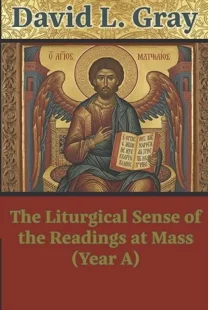
Image: Photo by Mateus Campos Felipe on Unsplash