How much do you remember of last Sunday’s homily? What was it about? What about the one before that? Were they memorable, outstanding preaching moments? Pope Benedict, writing as Cardinal Ratzinger, wrote that preaching in modern times was in “crisis.” No end of surveys has validated that comment. What, exactly, is the problem with the homily? Pope Francis, in the Apostolic Exhortation Evangelii Gaudium, put the problem succinctly: “We know that the faithful attach great importance to it, and that both they and their ordained ministers suffer because of homilies: the laity from having to listen to them and the clergy from having to preach them! It is sad that this is the case.” (135) Yikes! The homily is looked at as suffering?! Do some people really experience the homily as purgatory – something we just need to put up with, is somewhat painful, and which we are required to sit through, counting the time till it is over and we get on with things?!
As a professor of homiletics at St Augustine’s Seminary in the archdiocese of Toronto, my work has focused on helping seminarians deliver effective and engaging homilies. One thing we discuss is that the preacher cannot expect the listener to work at listening. If he does have wonderful listeners, he is truly blessed. It is the preacher, with the grace of the Holy Spirit, who needs to put his work, time, and commitment into the homily so that it is engaging with a message worth giving. That is, rather than blaming the congregation for not being attentive, for being poorly catechized, or not receptive to a counter-cultural message, it is the preacher who needs to preach a homily that effectively engages the listener with a message worth making and that sticks. The people have, after all, the right to a well-celebrated Mass, which includes a well-crafted and well-delivered homily.
That, however, is not the whole story here. Even if the preacher cannot rely upon it, people in the pews can and should be that blessing to a preacher by being good listeners of the homily, and in so doing, receive a blessing themselves. The Church teaches that the homily is an integral part of the Mass. The Catechism of the Catholic Church, referring to the Sacrament of the Mass, makes the important statement that although the power of Christ and the Holy Spirit is there, “nevertheless, the fruits of the sacraments also depend on the disposition of the one who receives them.” Similarly, what listeners get out of the homily also depends on their disposition and what they put into listening. Pope St Paul VI in Mysterium Fidei tells us why. Writing of the presence of Christ, he states, “in still another very genuine way, He is present in the Church as she preaches.” (36)
How To Listen To The Homily
So, if we want to be that gift to the preacher, and if we want to be blessed at the moment of the homily, just how do we approach it with the right disposition? Each of us sitting in the pews can be a model for others by taking a few good steps.
1. Read the Missal in Advance of the Homily
The Church has called us to pray with Scripture. Many do that with the Divine Office. A prayerful reading of the Mass texts before Sunday is yet another way to encounter Christ through the Scriptures. Reading both the liturgical prayers of the Mass and the lectionary readings is the first good step to a fruitful listening of the homily. By doing that, what is read and prayed at Mass becomes familiar. When we hear them prayed and proclaimed, they become reinforced because we have heard them before. People often forget what the first reading was by the time they hear the Gospel, but reading the missal in advance of the Mass reinforces what we will hear when proclaimed.
Most importantly, reading all the Mass texts in advance prepares us to hear the connections that the preacher can make in the homily, showing how the readings converge. The first reading was, after all, selected to accompany the Gospel, and the psalm responds to the first reading. What about the second reading? The Homiletic Directory tells us that although the second reading is a semi-continuous reading of the epistle, even so the unity of all the Scriptures makes all the readings “mutually revelatory.” (19) In the same way, knowing the antiphons, collect, prayer over the gifts, and closing prayer in advance also prepares us so that rather listening on automatic pilot, we are more attuned to hear a common thread.
2. Decide to Find Something Useful
Everyone’s situation is different. Everyone has different blessings and challenges. We can bring that experience to the Liturgy of the Word so that everything we hear becomes useful. One way to do that is to listen attentively for something that we can take away from the homily that makes a difference. It might be a clearer understanding of some part of Scripture or the faith about which we were unsure. It might be some practical suggestion from the homily that we can take as our next good step. Deciding to listen for something of concrete value, a pearl of great price, gives us focus and engagement.
3. Move Past the Bumps on the Road
Certain things can bother us in the preaching. It might be an aspect of the preacher’s delivery, such as a monotonous tone, a heavy accent, or low volume. It might be something that the preacher says that just rubs us the wrong way. We should certainly not deny or overlook these bumps on the road. They might even be something about which we need to give feedback to the preacher.
If our thoughts are preoccupied by what bothers us for the rest of the homily, we are setting ourselves up to miss what may be valuable in the preaching. A powerful practice, and a charitable one, is after recognizing what does not sit well with us, we put it aside till later and instead continue to look for something that will be to our advantage – something in the homily that will help us live out our lives as Catholic Christians. That means an attitude that does not dismiss an entire homily because of some aspect that just comes across as off.
4. Articulate the Message
St. John Henry Newman wrote that every homily should have a “bulls-eye”, “a definite point before him which he has to hit.”4 Bishop Ken Untener, who dedicated much energy to improving the state of Catholic preaching, called this central message of the homily “the pearl”5 So, what is the bulls-eye or pearl of the homily to which we are listening? A good practice for listening to the homily is to ask ourselves what we would say to someone at lunch after Mass if asked what the homily was about today. How would we phrase that in a single sentence that accurately conveys the message? When we find the words to do that, we know we have heard the homily.
5. Formulate a Question
We can more deeply listen to the homily by crafting a question about what the preacher has said. That question might ask for clarification of a point. It might be a question asking how something in the Scriptures or in the homily can be applied to contemporary life. It might be simply a wonder of how to do what the homily calls for. That question can be the beginning of a fruitful discussion around the table with others who have heard the homily, or even a question that we bring to the preacher himself. In this way, we extend the homily beyond the occasion of its preaching in the Mass into our conversation and thinking after we leave the church.
Listening and hearing are not the same things. We can often hear without really listening because hearing is passive. The homily is over, and we suddenly realize that we do not remember much. Listening, on the other hand, is active. Good listening requires engagement and a decision to apply the kind of specific strategies discussed above. Not everyone will do that. We might work on our shopping lists or let our thoughts meander during a homily as if the Mass is just on pause. That is an easy route to take while sitting in the pew, but one which means we will miss an opportunity to gain something valuable by being engaged. That engagement does take some work, but as with everything, dedication and work bring benefits – and for listeners of the homily at Mass, those benefits might just be great blessings.

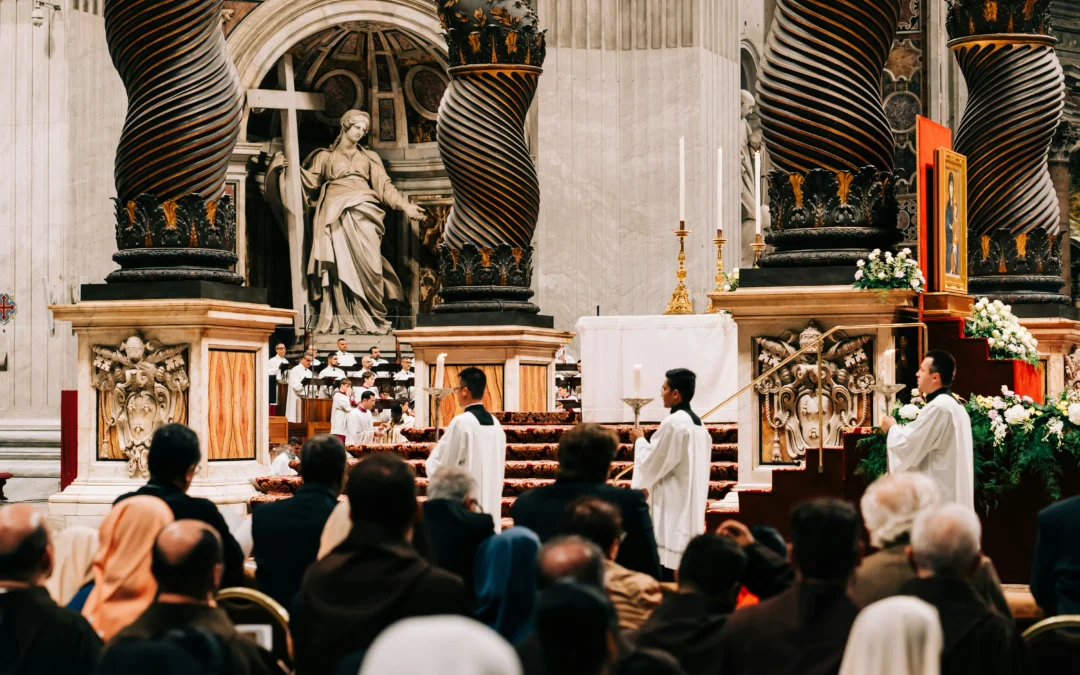
Image: https://unsplash.com/photos/a-large-group-of-people-in-a-church-nCF7vsl7hYk