The eleven disciples went to Galilee,
to the mountain to which Jesus had ordered them.
When they saw him, they worshiped, but they doubted.
Then Jesus approached and said to them,
“All power in heaven and on earth has been given to me.
Go, therefore, and make disciples of all nations,
baptizing them in the name of the Father,
and of the Son, and of the Holy Spirit,
teaching them to observe all that I have commanded you.
And behold, I am with you always, until the end of the age.”
The Relationship Between Ascension and Descension, Anabainō and Katabainō
The Ascension of Christ Jesus is regarded as the culmination of the theological concept known as the divine exchange, whereby God assumes human nature to enable humanity’s participation in divinity. The event signifies the elevation of humankind through divine grace and establishes a path for union with God. Through this ascent, Catholic Christian doctrine holds that Christ provides an opportunity for deeper communion with God and access to His love and presence. The Ascension is commemorated as a moment representing transformation, hope, and the promise of eternal life, emphasizing humanity’s potential for spiritual advancement.
Indeed, Catholic Christianity is a religion of ascent, an upward-moving faith, and we are a people being raised, lifted up, and ascending into Christ Jesus. For this reason, the liturgy itself is not only a participation in transforming our basic nature into a higher, divine nature, but in its very form, the liturgy physically lifts us upward, elevating our transformed natures into the Kingdom of God, our Father’s house. If you doubt this essential mission of the Christian faith, consider the Gospels, where the imagery of ascent is almost always linked to some form of transformation, while the imagery of descent is consistently associated with our basic human nature, which is now ready to encounter Jesus Christ.
In the Gospels, the preferred Greek word for descending is katabainō, which contrasts with kathēmai, meaning simply to sit down. For example, in Matthew 14:29, “Jesus said, ‘Come.’ So, Peter got out (katabainō) of the boat and walked on the water toward Jesus.” In Mark 15:30, they taunted Jesus to descend on their terms: “save yourself, and come katabainō from the cross!” Jesus would descend from the Cross to meet us, but it is always on God’s terms. This idea of ascending from descending highlights that it is only by God’s grace and mercy that we can come to the Father, ascending through Christ Jesus.
In the Gospels, the Temple in Jerusalem is seen as the pinnacle of ascent, and Jesus continually rises toward His passion. However, He first descends to preach, teach, and heal. From the very beginning, we see this pattern in Luke 2:51: “After the Finding in the Temple, He descended – katabainō – with them and came to Nazareth, and was obedient to them [Joseph and Mary]; and His mother kept all these things in her heart.” It is true that the first encounter of our Lord was with His parents.
Before Jesus encounters the rest of us, He also undergoes His ministerial transformation, which John the Waymaker witnesses, saying, “I saw the Spirit descend as a dove from heaven, and it remained on Him.”
Later, Jesus uses this same language in another sacrament, the Holy Eucharist, saying, “I am the living bread which katabainō from heaven; if anyone eats of this bread, he will live forever; and the bread which I shall give for the life of the world is my flesh.”
Descending marks the beginning of the Christian encounter. It is the point where we realize how fallen and low we are in our natural state, yet in Christ Jesus, we find hope to rise above our miserable condition and into our Father’s estate, which is our true inheritance. The Greek term best suited for this in this context is anabainō, meaning ‘ascend,’ contrasting with katabainō. It is not egeirō, which means ‘to arouse,’ as in, “God is able from these stones to raise up (that is, arouse) children to Abraham,” not to ascend children to Abraham. Here, God is not promising any transformation of the rocks but simply that rocks will remain rocks, yet be aroused. Some uses of anabainō also refer to the Sacrament of Baptism. According to Matthew 3:16, “When Jesus was baptized, He anabainō – ascending immediately from the water, and behind, the heavens were opened and He saw the Spirit of God katabainō like a dove, and come on Him.”
For Mark, the appointment of the twelve apostles was also a transformative ascent; he writes, “Jesus ascended the mountain, and called to Him those whom He desired; and they came to Him,” meaning they too ascended to Christ to associate with Him, which is a type of Sacrament of Holy Orders, where the ordination, also called consecration (literally meaning, ‘being associated with the divine’). Additionally, when describing the descent to meet His parents, Luke 2:42 states, “And when He was twelve years old, they ascended – anabainō according to custom.”
There is always a relationship between ascension and descending, anabainō and katabainō. The same applies to the Sacrament of the Holy Eucharist in John, where Jesus says, “If this shocks you, then what if you were to see the Son of Man ascending to where He was before,” which prophetically links the Eucharist’s descent with His Ascension after the Resurrection.
This passage aligns with the account from the First Reading in Acts 1:1-11 for the Solemnity of the Ascension. Verses 6-9 state, “When they had gathered together, they asked Him, ‘Lord, are You at this time going to restore the kingdom to Israel?’ He answered them, ‘It is not for you to know the times or seasons that the Father has established by his own authority. But you will receive power when the Holy Spirit comes upon you, and you will be my witnesses in Jerusalem, throughout Judea and Samaria, and to the ends of the earth.’ When he had said this, as they were looking on, he was lifted up, and a cloud took him from their sight.” The very thing that Jesus prophesied in John 6 — “If this shocks you, then what if you were to see the Son of Man ascending to where He was before” — happened.
Indeed, one thing we might overlook about the anabainō of our Lord is how shocking the actual ascension must have been. Jesus was right. The event of His ascension had to be much more shocking than His teaching that eating His flesh and blood would grant us eternal life. Consider this from the apostles’ perspective: first, there was about a three-year ministry during which they followed Jesus everywhere; then an emotionally wrenching night that led to His crucifixion; then three days later, His shocking resurrection and return; and now, forty days later, He is lifted into the sky, and a cloud took Him from their sight.
That had to be shocking, maybe even a little overdramatic, even for God, who is the author of all drama. But instead of letting them stew in their shock, today’s passage concludes, “While they were looking intently at the sky as he was going, suddenly two men dressed in white garments stood beside them. They said, ‘Men of Galilee, why are you standing there looking at the sky? This Jesus, who has been taken up from you into heaven, will return in the same way as you have seen him going into heaven.'”
If only our eyes could truly see what happens during the moment of consecration in the Mass, we would also be there, shocked, as the sky above the priest breaks open and Jesus descends again to meet us beneath the appearance of bread and wine.
It is true. The very reason we celebrate the Solemnity of the Ascension is because He first descended to us. This is the story of salvation history — God reaching out to us so that we can come to Him. In Christ Jesus, we now have the means to complete the journey. The Christian life begins with this pattern of descending and ascending in Baptism, where we are immersed and raised up — immersed and raised up — immersed and raised up a third time in the name of the Father, and of the Son, and of the Holy Spirit.
Katabainō and Anabainō. Katabainō and Anabainō. Katabainō and Anabainō. In nomine Patris et Filii et Spiritus Sancti. It is a beautiful thing that we witness at every elevation of the Holy Eucharist during the Mass. The Body of Christ ascends before us and descends into our bodies. Katabainō and Anabainō.
The Second Reading at the Divine Symphony for the Solemnity of the Ascension, drawn from Ephesians 1:17-23; the optional Second Reading from Hebrews 9:24-28; 10:19-23, and the Gospel Reading from Luke 24:46-53, all pertain to the reasons why our Lord Jesus Christ ascended. These reasons include: for us, for our sake, for our salvation, for our intercession, and for our judgment. The justification for trusting Him in these matters is not solely because He is God and He is true, but because He dwelt among us and continues to reside within us to this very day.
The liturgy of the Mass captures all of this drama, from Baptism to the dismal moments and everything in between. From our ascending processions to the sanctuary, to communion. From standing, sitting, and kneeling, Katabainō and Anabainō. From the great descent of Christ Jesus, the Holy Eucharist into our bodies, so we might leave the Temple Mount of the New Jerusalem and go into the world to be a type of Him; that is, a eucharistic people in the world to encounter those far from Him, who is the true Temple, who has ascended for our sake. We cannot miss this key point of the Solemnity of the Ascension: it is not about Him alone, but about all of us being called to come to Him; to ascend to where He is through God’s grace and the Sacraments of His Church.
Looking for more Catholic reflections like this one?
The Liturgical Sense of The Readings at Mass – Year A by David L. Gray offers a transformative journey through the Sunday Mass readings and Holy Days of Obligation, inviting both clergy and laity into deeper communion with the living Word and the rhythm of the Catholic liturgy. Rooted in the Liturgical Sense of the Scriptures, this book reveals the dynamic and mutual illumination between the Word of God and the ritual life of the Church, allowing every reading and prayer to draw the faithful further into the mystery of Christ and the mission of the Church.
Spanning the full structure of the Mass, from the Opening Rite to the Concluding Rite, Gray’s thoughtful commentaries provide a lens through which the Mass and the Bible mutually interpret and enliven one another. Readers are encouraged to go beyond passive attendance and embrace active participation in the sacred mysteries. This volume is more than a guide to Scripture—it is an invaluable resource for homily preparation, personal study, group discussion, and spiritual renewal, challenging all who approach it to contemplate more deeply, pray with greater sincerity, and live with intentionality as missionary disciples.
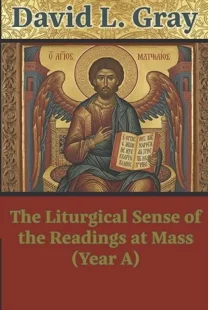
Image: https://upload.wikimedia.org/wikipedia/commons/8/88/The_Ascension_of_Christ_MET_DP280379.jpg