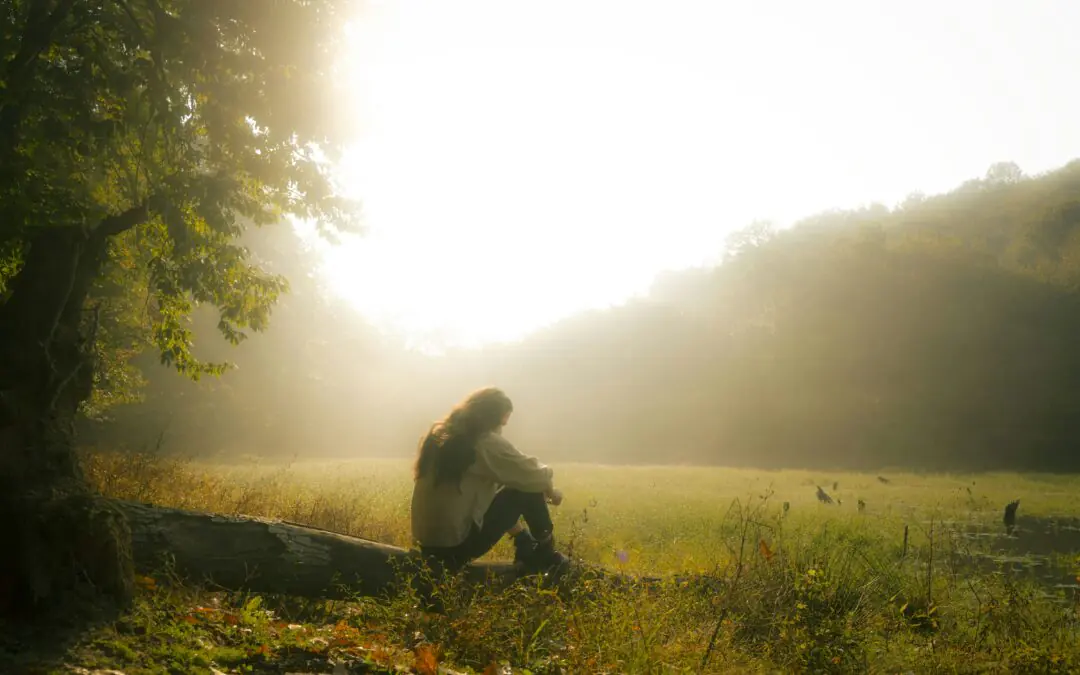
The sun is shining, the sky is blue, the world is a beautiful place. What reason does that woman have to be joyless? And why should that girl be fearful?
However, we see that both of them are alone, and it is only when they encounter one another that sadness and fear are transformed.
In fact, it is in sharing their sadness and fear that they become joyful and unafraid.
A deeper look
As the poet John Donne tells us, ‘no man is an island’. We are not made to live in isolation, as an unconnected group of individuals. We are called to encounter with others, with God and with ourselves. But it goes beyond that. The encounter we are called to is not just about everyday conversations and superficial interactions we have with the people around us. In the same poem, Donne wrote, ‘I am involved in mankind’ and it is this involvement, this encounter which is a part of our very identity. It is about letting others see our hearts, which is potentially scary, and looking for what is beneath the surface of other people. Otherwise we end up something like what happens if you dropped a box of ping-pong balls: each ball is empty, and every encounter drives us further away from others until there is just scattered chaos.
Pope Francis has spoken frequently about the importance of building a ‘culture of encounter’: “In many places, generally speaking, due to the economic humanism that has been imposed in the world, the culture of exclusion, of rejection, is spreading. There is no place for the elderly or for the unwanted child; there is no time for that poor person in the street. At times, it seems that for some people, human relations are regulated by two modern “dogmas”: efficiency and pragmatism….have the courage to go against the tide of this culture… Have the courage to go against the tide of this culture of efficiency, this culture of waste. Encountering and welcoming everyone, solidarity – a word that is being hidden by this culture, as if it were a bad word – solidarity and fraternity: these are what make our society truly human.” (Rio de Janeiro, Brazil, August 2013) This culture of encounter, our willingness and ability to encounter others, is a direct result of our encounter with Jesus.
Thinking like an apostle
Encounter requires openness on both sides. God is always open to the encounter with us: “Behold, I stand at the door and knock; if any one hears my voice and opens the door, I will come in to him and eat with him, and he with me.” (Rev 3:20). The opposite is not true: we are not always open to encounter Him, whether through fear, prejudice, misunderstanding, wrong priorities or any other number of obstacles I could mention. When it comes to other people, the same obstacles are present, only how much more difficult it can be when they are present on both sides!
When someone is suffering, or just sad, it is often more complicated, because suffering itself becomes a two-way barrier to encounter. Suffering can make it hard for us to let anyone else in, but we can also become so wrapped up in ourselves and our own suffering that we don’t seek to encounter anyone else: the world becomes all about us. We also start to believe that the effects of encountering or not encountering are only in us, or that encounter will only be a negative experience for others and we need to protect them from it as well as ourselves. But we have already said that no man is an island: if I withdraw myself from encounter with those around me then those people are also affected. Suffering is hard, but suffering alone is much harder still, because in rejecting all encounter we deny a fundamental part of our being. Just as God is a Communion of Love, Father, Son and Holy Spirit, we, who are made in his image and likeness, are called to live in communion with Him and with others. In doing so we become more like Him and therefore more fully ourselves and this can only result in us becoming more joyful and less fearful.