A German priest named Fr. Peter of Prague was struggling with his faith in the Most Holy Eucharist. He saw around him a lack of interest on the part of the laity, a general immorality and laziness of the clergy, and a lack of reverence for the Sacred Liturgy. He found it difficult to believe that our Lord Jesus would share with us His very Body and Blood in the Holy Eucharist.
This was in the year 1263, not long after the Church declared officially the doctrine of transubstantiation in 1215 at the Fourth Lateran Council. Transubstantiation, simply put, means that through the calling down of the Spirit and the words of consecration at Mass, the ordinary bread and wine change the entirety of their substance into the Body, Blood, Soul, and Divinity of Jesus Christ, with only the mere appearances remaining.
This has been the consistent and perennial teaching of the Church since Christ. The Church knows that Jesus was not speaking metaphorically in the Upper Room at the Last Supper. Further, the Church Fathers, in the earliest days of the Church used words similar to transubstantiation to connote a true change had taken place.
A Pilgrimage and a Miracle
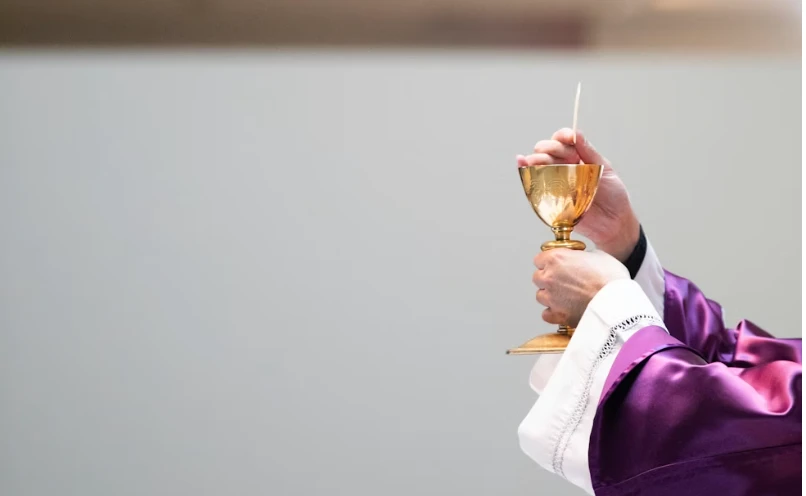
At the bequest of his spiritual director, Fr. Peter made a pilgrimage to Rome. On his way, he stopped in the town of Bolsena, north of Rome. He offered Mass at the tomb of St. Christina. At the words of consecration, “Hoc est enim Corpus meum (For this is My Body),” the Host began to bleed. Blood fell onto his hands and onto the white cloth on top of the altar cloth called a corporal.
Shocked and moved by what had taken place, Fr. Peter stopped Mass and told the congregation what had happened. He then went ten miles away to the town of Orvieto where Pope Urban IV was living. He placed the Host in the corporal, carefully folding it, and then went to tell the Holy Father what had happened. Pope Urban IV ordered an investigation which found that a miracle had taken place.
The relics (the Host and corporal) were taken by a solemn and joyous procession to the Cathedral of Orvieto where they remain almost 800 years later.
The Feast of Corpus Christi
A year later, Pope Urban IV instituted the feast of Corpus Christi (the Body of the Christ) as a day to especially recognize and promote the gift of the Blessed Sacrament. St. Thomas Aquinas and St. Bonaventure were asked by the pope to create hymns for this new feast. St. Thomas Aquinas was also asked by the Holy Father to compose prayers for the Mass and the Liturgy of the Hours for Corpus Christi. He also composed the great Eucharistic hymns still sung today: Panis Angelicus, Pange Lingua, O Salutaris Hostia, and Tantum Ergo.
In 2026, the forty days of Lent will begin on Ash Wednesday, February 18, and end on Holy Thursday, April 2. Easter Sunday is on April 5. During this sacred season, we are called to deepen our faith through prayer, fasting, and almsgiving. Catholic-Link has gathered a...
This reflection is an excerpt from The Liturgical Sense of the Readings at Mass (Year A). Click here to purchase! 6th Sunday in Ordinary Time — Year A First Reading: Sirach 15:15–20Responsorial Psalm: Psalm 119:1–2, 4–5, 17–18, 33–34Second Reading: 1 Corinthians...
Spiritual reading is an excellent way to grow during Lent, but knowing where to start can be difficult. Here are some of the Lent books our team at Catholic-Link has found worth reading during this holy season. 40 Lent Books For Catholics Aquinas’s Lenten Meditations:...
Triumph of the Heart "In the harrowing confines of Auschwitz's starvation cell, Catholic priest St. Maximilian Kolbe volunteers to die in place of another prisoner, joining nine others condemned by the Nazis. As despair and fear grip the group, the pressures of...
Kenny Loggins’ contributions to movie soundtracks, highlighted by his Academy Award nomination for “Footloose” in 1985, may be what keeps his music still alive today. But a song that he released eight years earlier is one that never fails to keep my hope alive, even...
It is common to enter dry spells in one’s marriage. Those warm and fuzzy feelings during the honeymoon phase sometimes come and go, affected by hormones, fatigue, and various stages of life. Even still, I know that it can be unsettling. You’ve committed to spending...
When you first meet someone, you’re curious to know them. You want to know how old they are, where they grew up, what they currently do, their best memories, etc. Perhaps, they’ll share with us something very unexpected — their vast knowledge of electric fish in...
Christ said, “by their fruits you shall know them” (Matthew 7:16). The Catholic Church, founded by Christ, possesses many fruits proving its lineage. Among these are miraculous signs that give hope to the faithful. One miracle I want to touch on in this article...
When I became Catholic fifteen years ago, I was amazed by all the organizations available to Catholic laypeople. They are the outward, organizational expressions of our “Catholicity”, our call to worship, to serve, to pray, to evangelize. I bet anyone reading this...
Not long after the New Year’s resolutions have faded, we Catholics are thinking about our next opportunity to make changes…the 40 days of Lent. Some of us rejoice and say, “Hurrah! A second chance to tackle those goals!” while others of us dread the penitential season...
When Jesus saw the crowds, he went up the mountain,and after he had sat down, his disciples came to him. He began to teach them, saying:"Blessed are the poor in spirit,for theirs is the kingdom of heaven.Blessed are they who mourn,for they will be...
Will Wright lives in Phoenix with his wife and sons and is a History and Religion Teacher at St. John Paul II Catholic High School. He is an adjunct instructor and Institute Fellow with the Institute of Catholic Theology in Phoenix and an instructor at the Kino Catechetical Institute. He is also a regular author for the website Catholic-Link English, many of his articles have been featured on “The Best of Catholic Blogging” column on the National Catholic Register website, and has been published with Adoremus Bulletin and SpiritualDirection.com.
Will earned a Bachelor’s Degree in History from the University of North Carolina at Chapel Hill. He also holds a dual course of study Master’s Degree in Catechetics & Evangelization and Theology & Christian Ministry from Franciscan University of Steubenville. He is currently enrolled with Pontifex University and working towards a Doctorate in Theology (ThD).