(Special Thanks to Adoremus and Dr. Denis McNamara)
The heavy lifting and much of the inspiration for this article is offered by Dr. Denis McNamara’s fantastic article “Altar as Alter Christus: Ontology and Sacramentality” from Adoremus. The Church is deeply indebted to Dr. McNamara for his passion, knowledge, and love of Jesus Christ and the Catholic Faith.
I highly recommend checking out Adoremus if you are interested in solidly researched and presented topics regarding the Sacred Liturgy.
The Altar is Christ
Dr. McNamara points out that Preface V of Easter in the Roman Missal says of Christ: “As He gave Himself into Your hands for our salvation, He showed Himself to be the Priest, the Altar, and the Lamb of sacrifice.” The altar, which is the center of the Eucharistic celebration, is both the place of sacrifice and the table of the Lord. On this altar, the sacrifice of Calvary is made present once more.
On the Cross, Jesus is the Priest because, as a Priest, He is offering Himself to the Father. He is the Altar because His Body is the place of sacrifice. He is the Lamb because, like the Passover, He is offered in our place.
So, it is not understandable to say that the Altar is Christ. In the words of Mother Church, the Altar is Christ standing in the midst of His People. Even when an altar is consecrated and dedicated, it is anointed with oil as the Body of Christ was anointed before His burial.
From the Visible to the Invisible
When the Word of God became man in the Person of Jesus Christ, the spiritual met the material. The supernatural shared in the nature of the natural. God took on flesh to share in our humanity. Heaven and Earth met. This has always been the way of the Church. The outward shows something deeper inward. In the Sacraments of the Church, most especially, signs and symbols become the outward showing of God’s inward grace. Hidden realities are made clear through the sacramental.
This is what signs and symbols in the Church can do for us: they use the visible to lead us to and show us the invisible. Especially in the Holy Mass, Heaven and Earth meet. This is why Church art and architecture matters so much. Good art and architecture show us the truth and goodness of God!
As Dr. McNamara rightly says:
“…this movement from visible signs to invisible spiritual realties does not always come easily. It requires bringing a receptive mind and heart to a foundational literacy of what external signs mean and how they are fulfilled in salvation history. But even the most highly educated person cannot encounter what is not present, and so theological knowledge matters when making any decisions about celebrating the sacred liturgy. If a worshipper is to be led to the mysteries, the signs necessary to encounter those mysteries must be there to be perceived.”
The Place of Sacrifice and Sacred Table
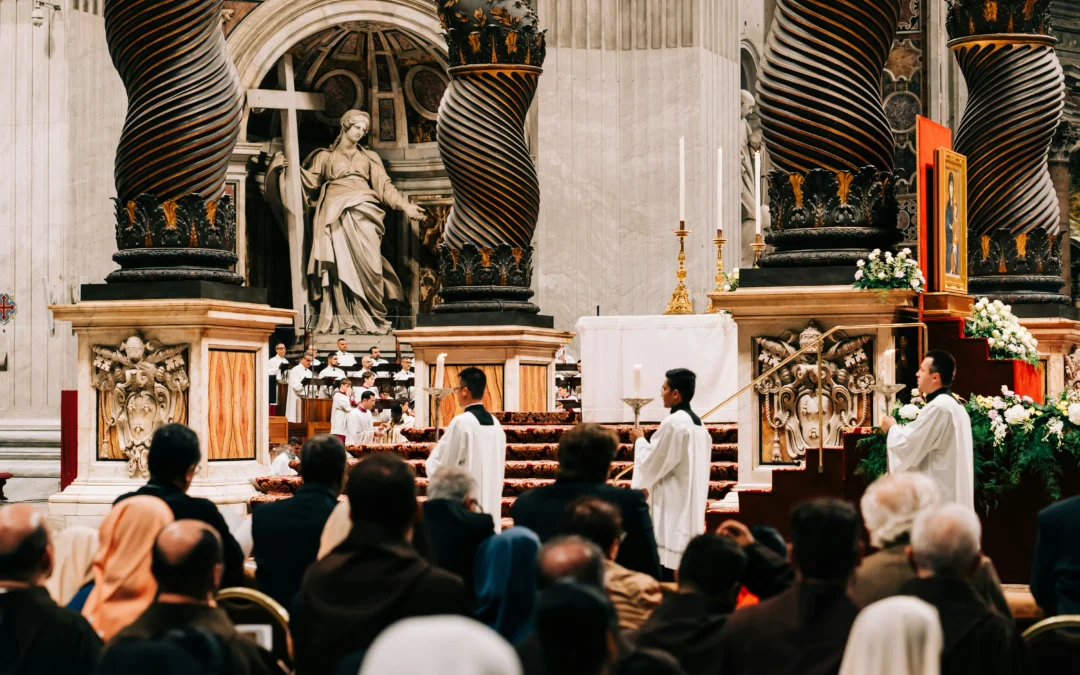
The Most Holy Sacrifice of the Mass makes present once again the Last Supper, the Passion of Jesus, the Cross, the Resurrection, and the Ascension. These events, outside of space and time, are made present by the power of the Holy Spirit and the mediation of Christ.
The Altar is not merely a table, even a sacred table. The Altar is first and foremost the place of sacrifice. The Holy Victim, who is also the High Priest, is offered on the Altar, which is His Body. The Holy Mass makes this reality present to us again.
As the Constitution on the Sacred Liturgy from the Second Vatican Council says, “in the earthly liturgy we take part in a foretaste of that heavenly liturgy which is celebrated in the holy city of Jerusalem (SC, 8).” So, the Altar is a living altar in Heaven and the meal we share is a heavenly meal.
The Altar becomes holy because of what it is and what happens upon it. As Dr. McNamara says, “While the altar does receive special treatment in its anointing, incensing, covering and lighting, The Order of the Dedication of an Altar indicates that ‘the altar becomes sacred principally by the celebration of the Eucharist’ (Adoremus, 2016).”
What is the Proper Gesture Towards the Altar?
It would be very unusual to bow to a table. If that is all the Altar is, then we would be out of our minds to do so. Of course, we know that this Sacred Table is the place of sacrifice. The Altar is Christ.
Jesus Christ is God Himself, the second Person of the Most Holy Trinity. He is our great High Priest. He is the Lamb of Sacrifice. He is also the King of the Universe. Even the worst kings and queens in history were honored by bowing and genuflection. How much more deserving is our perfect and infinite Lord!
The proper gesture towards the altar which is the sign of Christ standing in our midst is a profound bow, or a bow from the waist. The bow is a bending of the head or body in reverence and submission. One definition of “to bow” is to “cease from competition or resistance.” How often do we resist the Lord? But, of course, God Almighty is so far above us that resistance or competition is unthinkable.
By bowing, we remind ourselves of who God is and who we are. We are also reminded of what takes place and Who becomes present on the Altar during Holy Mass.
When Do We Genuflect?
The genuflection, or bending at the knee, is a sign of profound respect and adoration. Speaking of Christ Jesus, St. Paul writes:
“Therefore God has highly exalted him and bestowed on him the name that is above every name, so that at the name of Jesus every knee should bow, in heaven and on earth and under the earth, and every tongue confess that Jesus Christ is Lord, to the glory of God the Father (Philippians 2:9-11).”
We bow in the presence of our Eucharistic Lord, present in the Tabernacle. We bend our knee to the one and only God and Lord of all. The Altar makes Christ present in a particular and special way, but the Holy Eucharist IS Jesus.
So, with all of the explanation behind us:
We bow to the Altar. We genuflect to our Lord in the Tabernacle.
More Catholic Resources On Genuflecting And Bowing