Nearly twenty-five years ago, St. John Paul II issued a bold summons to the Church: he called us to “put out into the deep” of the internet, which he described as a “new forum for proclaiming the Gospel.” Since then, Pope Benedict XVI exhorted us to “walk the roads of the digital continent,” and Pope Francis has challenged us to create an “encounter of hearts” rather than simply generating content. Most recently, Pope Leo’s remarks to “digital missionaries” remind us that our online presence is not just a digital billboard, but a vital space for evangelization. This call from our recent popes is for all of us, but especially for Catholic organizations in a unique way.
For many parishes, dioceses, and ministries, digital communication and engagement feels like a burden – another email, another platform, another task pulling us from what matters most. At eCatholic, we understand the administrative pressures placed on those in ministry, and we aim to help Catholic organizations communicate clearly and efficiently so they can focus on the heart of their mission: to engage and evangelize.
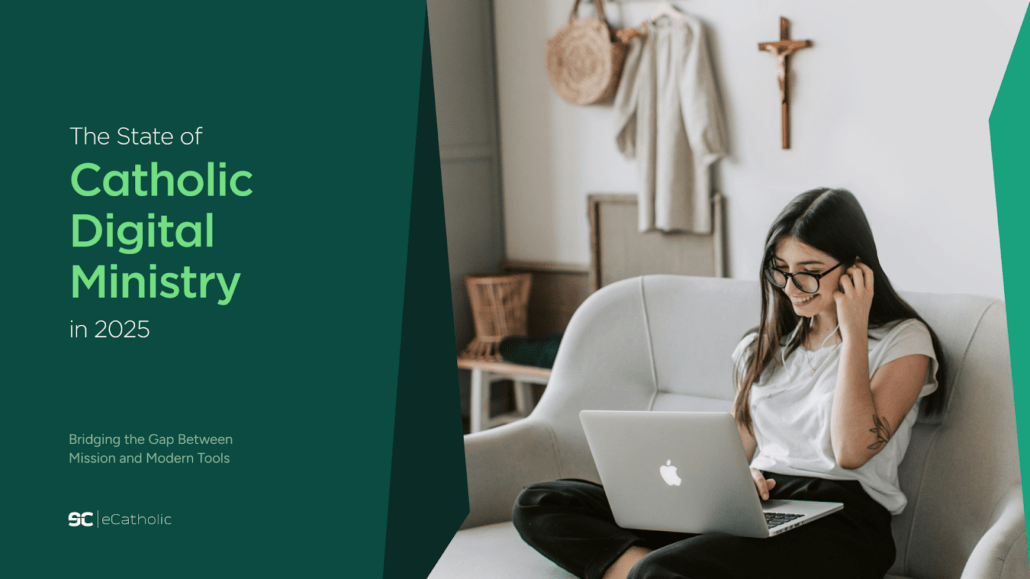
eCatholic recently conducted The State of Catholic Digital Ministry in 2025 survey, gathering more than 23,000 data points from nearly 500 Catholic organizations. The results revealed what has been coined the Digital Engagement Gap: a disconnect between what leaders hope to accomplish online and what they feel equipped to do with the tools, time, and training available.
Here are five data-backed steps to take your parish from “overwhelmed” to “equipped” in 2026:
1. Appoint a “Digital Point Person”
One of the most telling findings from our report is that only 21% of parishes have a clearly defined role responsible for digital ministry. In most cases, responsibilities are fragmented or absorbed by individuals without the training or authority to make lasting improvements.
“We found that 86% of parishes surveyed don’t feel qualified and do not have anyone assigned to lead their digital ministry efforts,” notes Jason Jaynes, CEO of eCatholic. Even if you cannot hire a full-time director, designating a point person—even a volunteer—creates the accountability needed for steady execution and consistent messaging.
2. Solve for the “3 C’s” of Digital Maturity
Our survey found that progress doesn’t come from working harder, but from growing stronger in three specific areas:
- Clarity: Establishing clear roles, strategies, and goals so efforts aren’t reactive. It’s also helpful to remind yourself why this work matters. Even something as simple as clearly communicating Confession and Mass times can have a profound impact on someone’s spiritual life.
- Capacity: Ensuring staff have the time and tools needed for sustainable workflows. An integrated suite of tools, like what eCatholic offers, can streamline processes and save precious time.
- Confidence: Proper training boosts the effectiveness and efficiency of digital communication. When the person responsible for digital ministry feels confident using the tools at their disposal, meaningful gains are possible.
When all three are present, digital ministry shifts from “just another task” to an effective means of catechizing, fundraising, informing, and engaging.
3. Bridge the “Integration Chasm”
The data revealed a major structural barrier: only 7% of organizations reported having fully integrated systems. Most are dealing with a “disconnected pile” of software, where staff must manually copy and paste data between platforms – consuming time and introducing errors.
“We wanted to gain a clearer understanding of the technology gaps that exist within the Church,” said Jason Jaynes.
In 2026, prioritize simplifying the stack. When your website, messaging, and giving tools talk to each other, your team gains the capacity to focus on people rather than tech support.
4. Move from Passive Content to Active Messaging
While 99% of parishes have a website, only 74% are using messaging tools like email and text. A website serves as your “front door,” but it is passive – you’re waiting for people to come to you.
“Digital engagement is necessary,” one Director of Religious Education shared in our survey. “The generation coming up only knows digital spaces for finding information.” By using integrated messaging tools, you reach parishioners on their phones—the place where they already spend time. eCatholic’s Connect product makes it easy for parishes looking to add messaging tools in 2026.
5. Shift the Goal to In-Person Encounters
Digital tools are not just for marketing; they are tools for mission. Our report found that when digital goals are intentionally aligned with in-person ministry goals, parishes report higher confidence and more effective communication.
As a marketing leader, I’ve seen that the most successful parishes use digital engagement to draw souls hungry for truth, goodness, and beauty toward Christ, His Church, and the sacraments. Whether it’s an online retreat registration or a text reminder for new Adoration times, digital engagement should always be a means to the physical, sacramental life of the Church.
How eCatholic Bridges the Gap
At eCatholic, we don’t just provide software, we help close the Digital Engagement Gap. Our platform was designed specifically to address the challenges highlighted in this report:
- Integrated by Design: We replace the “disconnected pile” with an intuitive suite (websites, online giving, group messaging, live streaming, and church management software) that works as one cohesive system.
- Built for Capacity: Our tools are designed for everyone, from non-technical volunteers to advanced web developers, and built specifically for Catholic organizations. This simplicity helps teams get more done, faster, while staying focused on ministry.
- Confidence Through Support: We provide training resources and award-winning support to help parishes move from “basic use” to mission-driven excellence. Typical results include increased offertory, clearer communication, stronger engagement, and more informed parishioners.
“There is so much hope despite the challenges that small ministry teams in parishes face,” said Jason Jaynes. We want to close the digital engagement gap with a focus on clarity, capacity and confidence, with the goal to help all parishes and ministries self-evaluate where they are and determine how to better evangelize in our digital age.”
Ready to close the gap? Download the full State of Catholic Digital Ministry Report here and see how eCatholic can help your parish move from “stuck” to strategic.

Did you know ALL of Catholic-Link.org’s resources are free to use in your parish or ministry? Share them on social media, discuss them with your small group, print them in your bulletin…Make sure you subscribe to our weekly email to get seasonal content sent to your inbox.